
What is Land Development Feasibility Study?
Land development feasibility study is an analytical and systematic insight and study into the viability criteria of a selected plot or land
A land development feasibility study systematically collates all information and data on all the factors that make a plot or land worth investing in. It is a study of the potential of the land about how the land adds value to the property project, and how suitable it is for the proposed property development.
The purpose of the land development feasibility study is to collect and study data to help the property developer to ascertain:
- Commercial viability of the land
- Geo-stability of the land
- Social value and environment of the land
- Future growth potential of the land
- The value a piece of land adds to the project
- Suitability of the land for the proposed property development undertaking
- Probable challenges that the land poses
- The rules, regulations, and zonal laws around the land
- The advantages the land offers
- The flora and fauna and natural environment of the land like forests, rivers, vegetation, animal profile etc.
These are some of the important factors that influence the worth of a land. Accurate statistics and data and research of these influencing factors, through a land development feasibility study, helps the property developer to move forward with the design and development with greater confidence, credibility and efficiency.
A land development feasibility study is a bit different than property development feasibility, and it is mostly used to assess the best option for a land subdivision.
Consider a scenario where a developer (master developer) acquires a large piece of land with the purpose of sub-dividing it and selling to smaller developer. Usually, master developer provides infrastructure and utility to the newly created plot boundary. To assess the profitability of such venture, the master developer conducts land development feasibility study.
In any project requiring property development, the most important factor is the land. It is particularly important to ascertain the potential of the land. The potential of the land relates to many areas like the geo-stability of the land, its socio-political value, market value, and its growth prospects, and so much more.
A land development feasibility study provides all the relevant information to ascertain the practical and commercial viability of the selected land or plot.
You may also like to read the post what is a property feasibility study?
Objective of Land Development Feasibility Study
There are many areas of a piece of land or plot that need to be researched upon, before embarking upon building a property on it.
A good land development feasibility study helps to determine the suitability and the readiness of a piece of land for a proposed property project, whether for commercial use or personal use. It ascertains:
- How to maximise the advantages the land offers
- How to minimise damages and risks
- How to fortify and protect the project and property against environmental hazards like cyclones, earthquake, storms, floods, blizzards, extreme heat or cold, heavy monsoons etc.
- How to develop the best suited design
- How to lay out the best plan, which also safeguards the flora and fauna and natural resources of the area
- A land feasibility study considers all the features and challenges of a plot of land to determine if building on it is practical and profitable or not
The objective of the land development feasibility study is to compile an analytical study on a “Land-Use Profile” that holistically defines how the land can be used.
Land-Use Profile in Land Development Feasibility Study.
Land-Use profile sums up the entire essence of the land development feasibility study. In a nutshell, Land-Use Profile is a study that determines how the land can be used to its highest potential, and bring in the best returns for the investment on it.
Land-Use Profile helps to determine:
- Compatibility of the land with the proposed design and goal of the property to be developed on it
- Location of the land, which is a crucial factor in determining the practical and commercial viability of the property developed on it. Also, location of the land determines the accessibility of the property, and the easy availability of the utilities for it
- Comparative analysis on advantages of the selected land over other land-uses in an area. This supplies adequate data and argument as to why a particular land is preferred over other land in any given area
- Mapping or Cartographic representation is an important segment of Land-Use Profile in a land development feasibility study
A Land-Use profile takes into consideration
- Physical development in the proposed area
- Social Environment of the area about its classification based on monetary worth, social worth, and income profile of the area
- The existing pattern of ongoing development in the area
- A research outline that helps to predict the future use of the land
A Land-use profile collates all the information on past development, with the existing market structure, and the development prospects of the future. It takes into consideration people specific factors like:
- personal opinions
- desires
- attitudes
- legal and political considerations.
All of these impact the Land-Use Profile. A Land-Use Profile is an integral part of Land Development Feasibility Study, as it determines the most efficient and the most ethical use of the land, aligned with all applicable conditions, to unfold its highest potential, and minimise losses and damages.
I would also suggest reading this post on development feasibility study.
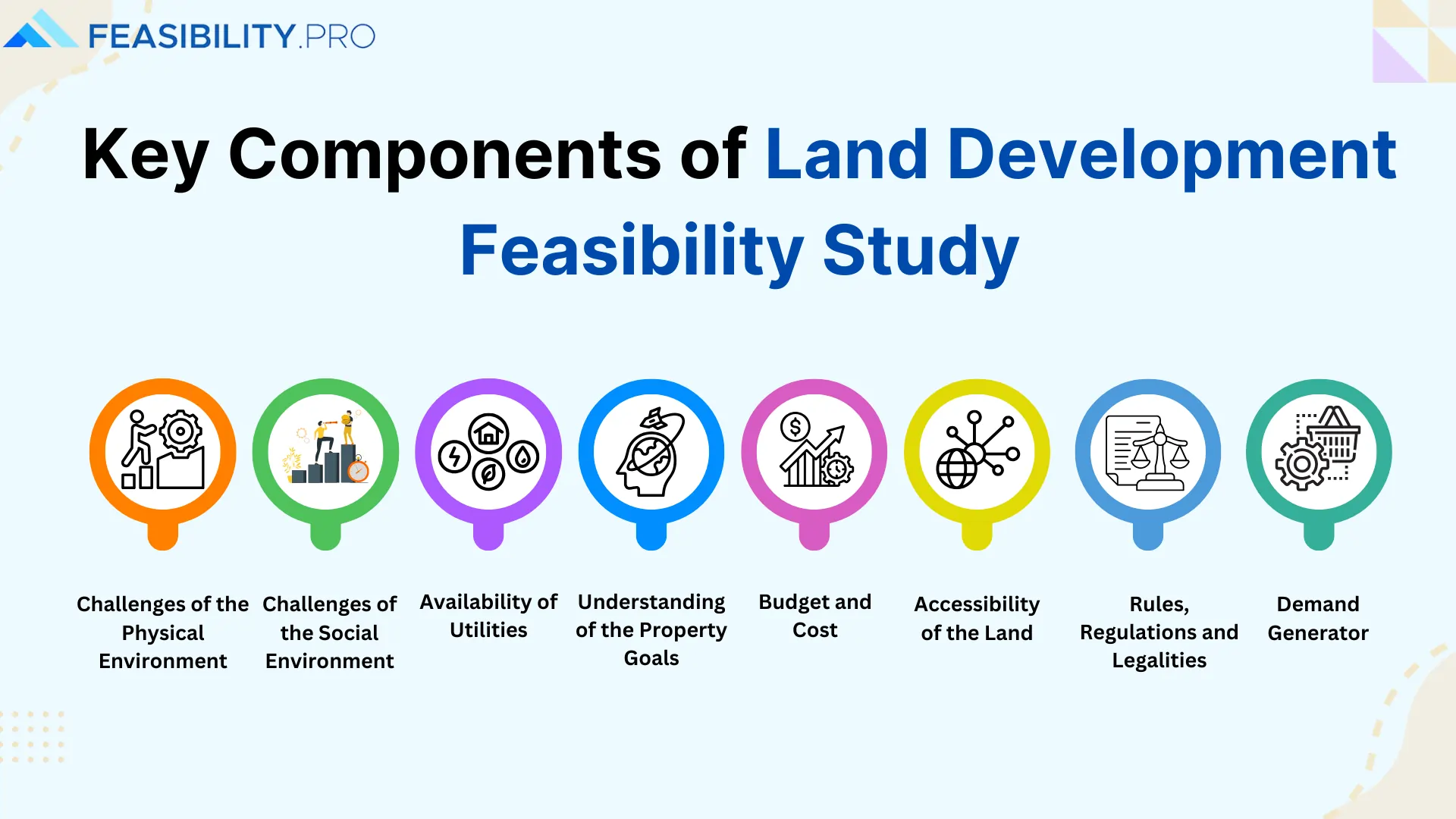
Key Components of Land Development Feasibility Study
There are many factors that characterise a land profile. The physical structure, commercial value, social environment, natural environment, all of these factors add up to define the profile of a land or plot.
A detailed study and analysis of the key components of a land profile is integral to a good Land Development Feasibility Study, that gives credibility to the property project, and gives the developer the confidence to move ahead.
Challenges are part and parcel of any venture. A clear understanding of the difficulties a proposed land area poses, is important in order to create those requisite changes in the design and planning, to ensure smooth, efficient and risk free operations. In a land development feasibility study, the challenges are primarily divided into two segments:
Challenges of the Physical Environment
This involves a study of:
- topography of the area
- flora and fauna
- geographic conditions like soil structure, water bodies, forests etc.
- climatic conditions
- stability of the land, as to whether it shifts or is set
Challenges of the Social Environment
This involves a study of
- The people demographic on salary, work environment etc.
- The socio-political environment of the area
- The commercial prospects of the area
- Rules and regulations
- Permissions
It is important to know these challenges and set a budget and a contingency plan for it, as well as weave it into the design, to ensure a successful and smooth project completion. Challenges are potential setbacks and they can severely affect the budget. Awareness about challenges reduces the risk of damages and slow-downs
Availability of Utilities
- Essential Infrastructure: Without reliable access to electricity, water, natural gas, and proper septic/drainage systems, no development can thrive.
- Detailed Assessment: A feasibility study meticulously checks the existing utility infrastructure, identifying any gaps or challenges in connecting to essential services.
- Cost Implications: It also provides clear insights into the potential costs and complexities of bringing these utilities to your site, preventing budget overruns down the line.
Understanding of the Property Goals
- Purpose-Driven Design: The intended use of your property – whether it's a private residence, commercial space, or agricultural land – dictates its design and structural requirements.
- Suitability Check: A feasibility study helps determine if your chosen land is genuinely suitable for your proposed design and purpose.
- Viability Assessment: It highlights if modifications to your design or even a different land parcel might be more viable for your ultimate goals, saving time and resources.
Budget and Cost
- Accurate Cost Estimation: This study provides a precise breakdown of all development costs, from land demarcation, leveling, and clearing to utility hook-ups and regulatory fees.
- Preventing Surprises: By offering a realistic financial outlook from the outset, it helps prevent unexpected expenses and ensures your budget aligns with the project's true scope.
- Informed Decisions: With clear cost data, you can make informed decisions about the project's financial viability and allocate resources effectively.
Accessibility of the Land
- Market Value Driver: How easily a property can be accessed by various modes of transport (road, rail, air, water) significantly impacts its valuation, market appeal, and future prospects.
- Crucial for Logistics: For commercial or residential projects, good accessibility is vital for commuters, deliveries, and overall convenience.
- Comprehensive Analysis: The study meticulously defines all access points and transportation links, assessing their current state and future potential.
Rules, Regulations and Legalities
- Zoning Compliance: Every area has specific zoning laws and regulations that govern land use and property development.
- Smooth Execution: The feasibility study compiles all relevant legal data, ensuring your project adheres to local ordinances and preventing costly legal issues or delays.
- Risk Mitigation: Understanding the legal landscape upfront helps to mitigate risks and ensures a smooth and efficient project execution.
Permissions
- Mandatory Approvals: Before any construction can begin, numerous permissions and licenses from local governing bodies are required.
- Avoiding Illegalities: Proceeding without proper permits can lead to severe penalties, project halts, and even demolition orders.
- Budgeting for Bureaucracy: The study provides a detailed list of all necessary permits, licenses, and the associated costs for documentation, legal processes, and consultations, ensuring this vital aspect is budgeted for.
Conclusion
When narrowing down on the most appropriate and suitable site for a land development project, it is important to have accurate information and statistics on all areas of influence on that land. A land development feasibility study provides a crucial and an in-depth insight into all aspects, challenges and advantages surrounding the land selected for the proposed property development. A land development feasibility study determines if the property development project is viable on the selected land or not. Or how it can be modified to bring in the best results. You should also explore below external contents on feasibility study: Hope you enjoyed this post on development feasibility study, let me know what you think in the comment section below.Feasibility.Pro Student Edition is 100 % Free Forever
Students and educators get the full desktop modeling engine at no cost. Verify your academic email once and keep using it for life.
Instant Download
Grab the Windows installer with one click – no credit card needed
Local Desktop App
Run natively on your PC for fast modeling and full offline access
Lifetime License
Verify once with your .edu or .ac email and renew annually at no cost
How It Works
STEP 1
Visit Download & Register
Go to download.feasibility.pro and click “Sign Up” to create your trial account. No credit card needed.
STEP 2
Download & Install
Download the Windows installer (.exe), run it, and follow the prompts (Next → Next → Finish). Feasibility.Pro will be ready on your desktop.
STEP 3
Verify & Unlock
Open the app, log in with your institutional email, then email support@feasibility.pro to upgrade from trial to a lifetime student license. License renews annually with a quick email confirmation.
No fees ever, no trial expirations – full access while you study










Hi,
I have a 3200sqm in Swansea town centre, Jockey Street, SA1 1NS.
I am looking for a company to produce a feasibility study on the potential development.
Can you have a service to help going forward?
Regards