

Real Estate Investment Like A Pro
Real estate remains a powerful engine for wealth creation. To truly invest "like a pro," you need foresight, strategic planning, and a deep understanding of market nuances, moving beyond just capital to make informed, data-driven decisions.
Key Global Trends Shaping the Market for Investors
Long-term drivers are shifting towards "the three Ds": demographics, digital, and decarbonization.
Demographics: Rapid urbanization and population growth are increasing demand for both residential and commercial spaces. Millennials are reshaping housing market reaching peak home-buying age and evolving household formations are significant drivers.
Digital: Technological advancements like smart home innovations, virtual tours, and digital transaction platforms are enhancing accessibility and efficiency. IoT in smart houses buildings is expected to significantly increase, offering features like automated lighting and energy monitoring.
Decarbonization (ESG): A growing focus on energy-efficient and eco-friendly construction is driven by stricter regulations and environmentally conscious buyers. This commitment to sustainability minimizes utility expenses and reduces carbon footprints.
The convergence of "Digital" and "Decarbonization" creates a strong investment case for modern, sustainable, and tech-enabled properties. Conversely, older, less efficient assets face obsolescence risk, leading to a widening performance gap. Investors must actively seek out or convert properties that align with these trends.
Geopolitical tensions and national policies introduce unpredictable risks, such as sweeping tariffs or changes to tax regimes. These can derail market forecasts but also create "rescue capital" opportunities for opportunistic investors.
You should also read why am I passionate about real estate?
Metric/Trend | 2025 Projections & Key Insights | Implications for Investors |
Interest Rates & Inflation | Central banks (ECB, BoE) cutting rates; Fed may cut less. Mortgage rates declining. | Increased demand & transaction volumes; market shift from moderation to upcycle. Lower borrowing costs stimulate activity. |
Global Economic Growth | IMF: 3.1% (2024), 3.2% (2025). Divergent regional recoveries (US resilient, Eurozone weak, China property struggling). | "Nuanced investing" required. Tailor strategies to regional strengths/weaknesses; uniform strategies ineffective. |
"The Three Ds" | Demographics: Rapid urbanization, population growth, millennials peak home-buying age. Digital: Smart home, IoT (50% increase by 2030), digital platforms. Decarbonization (ESG): Energy-efficient, eco-friendly construction, sustainability regulations. | Investment case for modern, sustainable, tech-enabled properties. Increased obsolescence risk for older assets. New construction/retrofits with these features will command higher value. |
Geopolitical & Policy Risks | Tariffs, immigration laws, tax changes (e.g., Spain's Golden Visa ending). | Unpredictable risks can derail forecasts; create "rescue capital" opportunities for opportunistic investors. |
Diverse Investment Options for the Modern Investor
Real estate offers a spectrum of investment strategies, from hands-on direct ownership to more passive approaches, depending on your capital, risk tolerance, and desired involvement.
Direct Property Ownership Strategies
These methods offer greater control and potentially higher returns but demand more active management.
Rental Properties (Buy and Hold): This long-term strategy (10+ years) benefits from appreciation and consistent rental income. While offering steady income, tax benefits, and inflation hedging, rising operating costs (especially insurance premiums and maintenance) are significantly eroding net profits for landlords.
House Flipping (Fix and Flip): Involves buying distressed properties, renovating, and quickly selling for a profit. It offers high ROI potential (average 28.7% in Q3 2024) and quick profits. However, it's cyclical, capital-intensive, and ROI has been declining since 2016, indicating increased market maturity and tighter margins.
Real Estate Wholesaling: Identifying undervalued, off-market properties, contracting them, and assigning the contract to another buyer for a fee, without taking ownership. It offers quick entry, low cash/credit requirements, and minimal risk, but income can be insecure, and it doesn't directly contribute to net worth.
Land Banking: Acquiring raw, undeveloped land and holding it for long-term appreciation, often due to future development potential. Advantages include appreciation value, inflation safety, and low maintenance. However, it involves complex zoning regulations, market uncertainties, and requires anticipating future development.
Commercial Real Estate (CRE) Direct Investment: Directly owning and managing commercial properties (office, retail, industrial, multifamily 5+ units). CRE offers stable cash flow and appreciation potential. However, it requires a higher capital outlay and greater management responsibility. The increasing adoption of hybrid work models is fundamentally reshaping demand for office spaces, leading to a "flight-to-quality" in inner-city locations.
Know More About Buying Commercial Property is easy, read this to become an expert
Passive & Indirect Investment Options
These strategies allow participation in real estate without direct property management.
Real Estate Investment Trusts (REITs): Companies that own, operate, or finance income-producing real estate, trading like stocks. They offer high dividends (required to distribute 90% of taxable income) and liquidity. However, REITs underperformed in 2024 and are sensitive to interest rate movements. Their performance in 2025 will be significantly influenced by interest rate stability and easing new construction supply.
Real Estate Crowdfunding: Investors pool money through online platforms to invest in various projects. This lowers the barrier to entry (some as low as $10) and offers diversification. However, platforms are relatively new, and investments can be highly illiquid.
Real Estate Syndication: Merging individual investors' capital to acquire and manage significant real estate projects, with a sponsor managing the property. Benefits include access to large-scale projects, high return potential, and professional management. However, syndications are illiquid, offer limited control, and require thorough due diligence on the syndicator. The shift towards alternative sectors like data centers, healthcare, and senior housing is creating new opportunities for syndications, but demands specialized expertise.
Read More About: Real Estate Investment – How to get started?
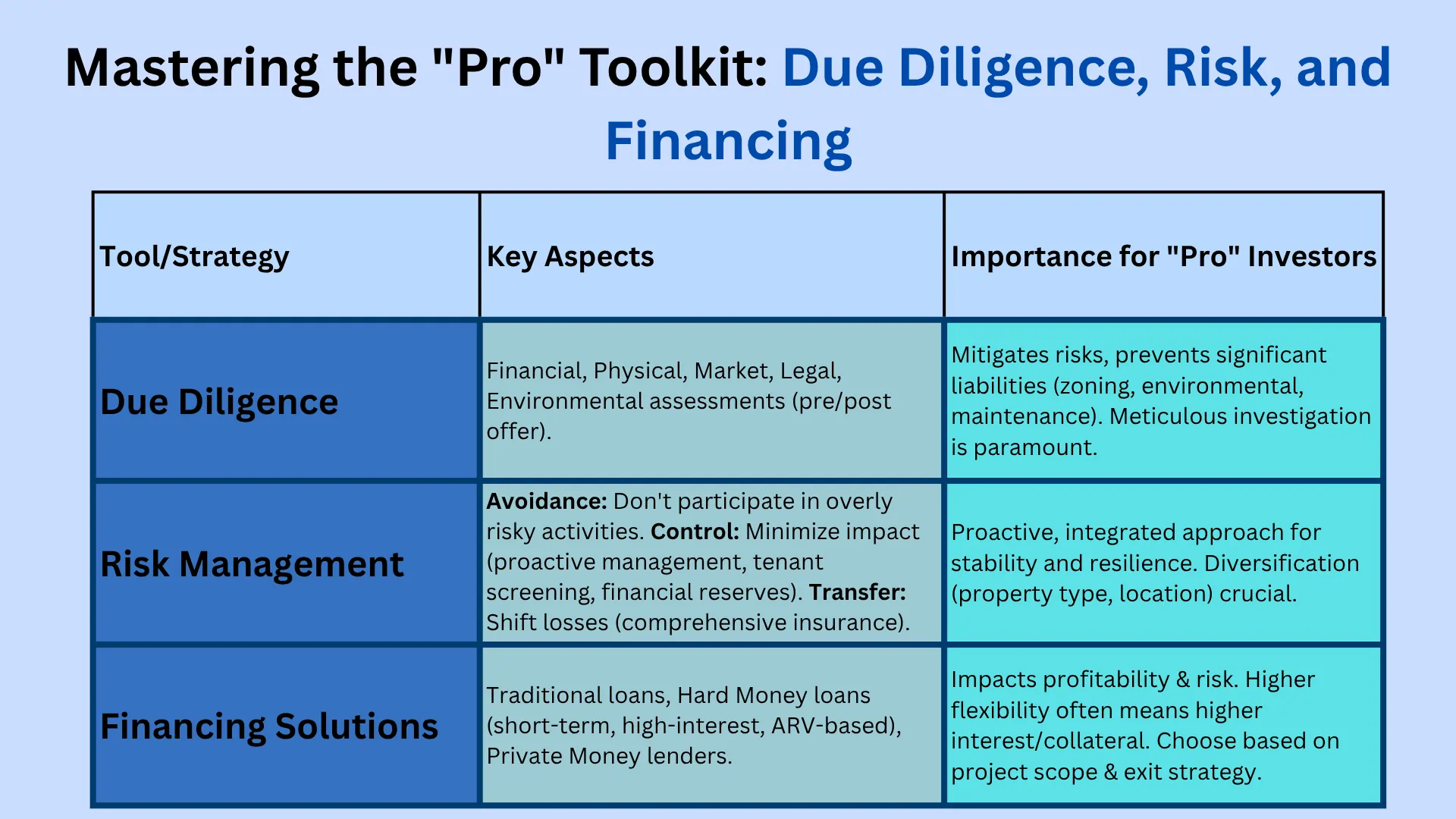
Mastering the "Pro" Toolkit: Due Diligence, Risk, and Financing
Investing like a professional means equipping yourself with essential tools and strategies.
The Art of Due Diligence
A comprehensive due diligence checklist is critical, involving two phases: pre-offer and post-offer. Key assessment areas include:
- Financial Evaluation: Reviewing income/expense statements, cash flow, tax records, and liens.
- Physical Inspection: Professional assessment of structural components, systems, and code compliance.
- Market Analysis: Researching local trends, values, rental rates, and future development plans.
- Legal Review: Verifying title, leases, and compliance with regulations.
- Environmental Assessment: Checking for hazardous materials or restrictions.
Overlooking minor details like zoning laws or underestimating maintenance costs can lead to significant financial liabilities. A professional investor prioritizes a meticulous, multi-faceted due diligence process.
Strategic Risk Management
Effective real estate risk management plans are built on three basic strategies:
- Risk Avoidance: Choosing not to participate in overly risky activities.
- Risk Control: Implementing plans to minimize potential impact (e.g., proactive property management, tenant screening, maintaining adequate financial reserves).
- Risk Transfer: Shifting responsibility for losses, primarily through comprehensive insurance policies tailored to property type and potential risks.
Diversification across property types and locations is one of the most effective ways to reduce real estate investment risks, protecting against local economic downturns and market saturation. Effective risk management is a proactive, integrated approach that builds stability and resilience.
Smart Financing Solutions
The choice of financing significantly impacts profitability and risk. Common options include:
- Traditional Loans: Conventional mortgages from banks with strict guidelines; commercial loans for CRE often have shorter terms and higher interest rates.
- Hard Money Loans: Short-term, high-interest loans from private lenders, flexible with credit but costly, often used for renovations based on "After Repair Value" (ARV).
- Private Money Lenders: Individuals or entities providing capital for properties, typically for short periods, requiring a clear exit strategy.
Also read the best way of structuring real estate deals.
Conclusion
Becoming a real estate pro means staying informed about global market dynamics, understanding diverse investment avenues, and meticulously applying due diligence and risk management. Ready to start your professional real estate investment journey?
Hope you enjoyed this post on real estate investment, let me know what you think in the comment section below.
You should also explore below external contents on the real estate investment:










Best lucrative channels for Real Estate Investment are smart living projects and specifically micro-apartments as they are the future of real estate. Here’s one lucrative project I came across for investment:
https://www.graana.com/project/9130/imarat-residences
Real estate investment aids you to accomplish your financial freedom goals by providing higher returns on your capital investment.
Find 1,2,3-bedroom Apartments For Sale in Lahore with Aetmaad. We are the leading real estate marketing agency in Lahore Pakistan with a 100% customer satisfaction ratio.
You may achieve your financial independence goals by investing in real estate since it provides greater returns on your investments.
Nice post. Thanks for sharing here useful topic. Ponmankal Homes in Kottayam stands out as a premier choice for those seeking modern, luxurious living in the heart of Kerala. Click here : Apartments in Kottayam