Property Tax in Canada
Which city in Canada has the lowest property taxes?
Property tax in Canada is progressive and simple. Each province has different property tax rates depending on the type of property and ownership.
Over the years, buying property in Canada has been profitable. So long as you understand the applicability of certain tax laws, you can make profitable real estate investments in Canada. When it comes to Canadian municipalities, real estate is still the major revenue source to fund a wide range of services.
Now, both business owners and residents must pay the required property taxes and the tax rate comes down to two major asset types - residential property and commercial property. Also, tax authorities in Canada exercise utmost discretion and due diligence to assign tax rates.
In Canada, you don’t need citizenship or residency to own or buy a property. For starters, people are free to occupy a residency temporarily and then adhere to immigration requirements to extend the stay. Yes, non-residents in Canada can also buy or own rental property. But these individuals have to file their annual tax returns with the CRA.

Let’s dive into the complete overview of property tax in Canada:
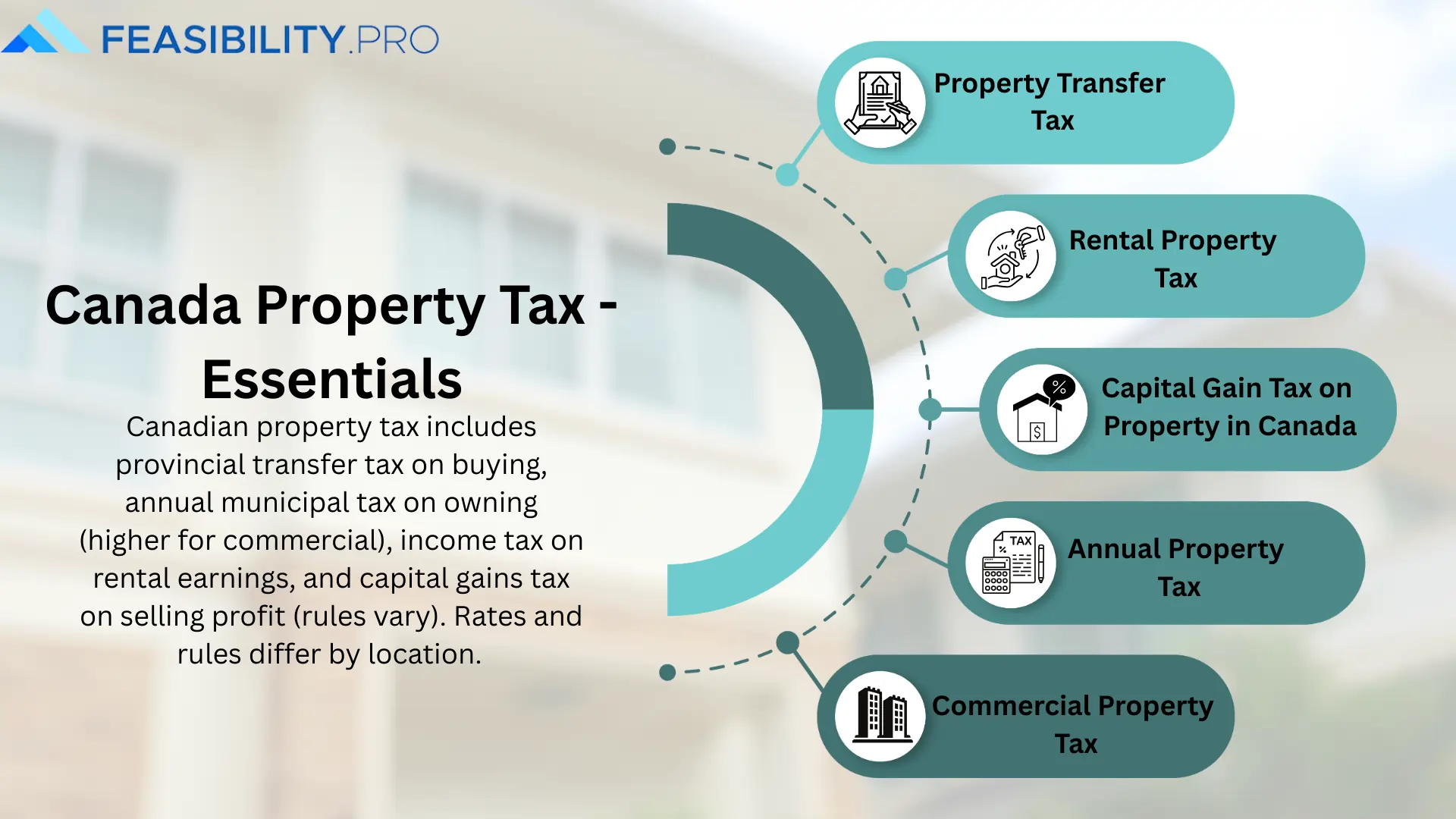
Property Transfer Tax in Canada
When you purchase a property in Canada, you have to cover the cost of provincial transfer tax that differs from one province to another. On average, it is 1% on the $200,000 and then 2% on the remaining balance. So, you will pay higher transfer tax for higher value property.
Of course, there are various tax exemptions for first-time property owners in Canada. At its core, municipalities levy the annual property taxes as per market value. In Canada, don’t forget that property taxes are deductible so long as it is an investment.
Rental Property Tax in Canada
According to Canada’s Income Tax Act, you have to pay 25% of total property rental income each year. On the other hand, non-residents have the option to pay 25% of their net rental income through NR6 form after expenses.
But if your rental property comes with net losses, you can reclaim paid taxes. It is crucial to understand that your net income is treated differently on a variety of factors. Ultimately, it depends on whether you’re a partner or co-owner. It also depends if you have a business or rental income.
Capital Gain Tax on Property in Canada
As a non-resident, if you decide to sell a property in Canada, the government will take half (50%) of your sale in the form of withholding tax. But if your gain is taxed, then you can avail it in the form of a foreign tax credit. If you’re a Canadian resident, then you don’t have to worry about tax on the capital gains while selling a property.
Annual Property Tax in Canada
This property tax is imposed on various kinds of property and the primary source of revenue for the local Government. Each municipality has its own unique tax formula to calculate the property tax, however, all property taxes in Canada are based on two critical factors: property value and the residential rate.
Vancouver has the lowest property tax rate in Canada. However, the city also has the most expensive homes, averaging above $1 million. Whereas Victoria has house prices averaging at $699,000, which is substantially lower, but its property tax rate is more than double as compared to Vancouver.
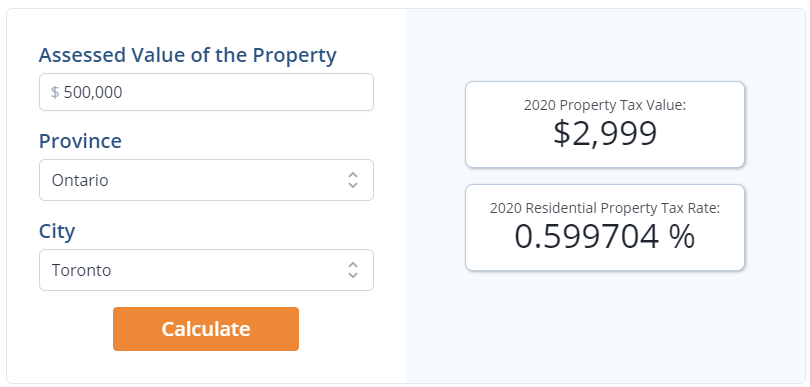
You can calculate the property tax for you property by using this property tax calculator.
Commercial Property Tax Rates in Canada
The commercial property tax rates in Canada are at least 2.5 times higher than residential tax rates. For 2020, the five cities with the highest commercial property taxes per $1,000 of assessed property value are listed below:
- Montreal – $36.99 per $1,000
- Quebec City – $35.03 per $1,000
- Halifax – $34.41 per $1,000
- Ottawa – $26.64 per $1,000
- Winnipeg – $23.17 per $1,000
The cities with the three lowest commercial tax rates per $1,000 of assessment were Vancouver ($6.73), Saskatoon ($15.65), and Regina ($17.31).
High commercial property taxes place a bigger weight on businesses to contribute an unequitable share of municipal budgets. It is important to balance the burden paid by businesses in each city. Lower commercial property taxes help make cities more competitive, stimulate job growth and investment, and consequently generate more stable and sustainable revenue.
You May Also Like To Read: What’s wrong with Canada real estate?
Canadian Commercial-to-Residential Tax Ratios
Taking the commercial and residential property tax data one step further, Altus Group calculated a commercial-residential tax ratio for each city. What’s interesting is that 5 of these municipalities have 2.5x higher commercial tax rates than residential tax rates in Canada. The data also shows that the commercial-to-residential tax ratios in 2020 had an average of 2.65% in 11 major cities.
In comparison, the 2019 commercial-to-residential tax ratio was 2.84%. The decrease in average pinpoints towards reduced ratios in Calgary and Vancouver. In 2020, the commercial-to-residential tax ratio of Vancouver reduced by 36.8%, whereas, Calgary’s tax ratio dropped by 22%. Interestingly, the tax ratio of Winnipeg continues to stay around 2.0.
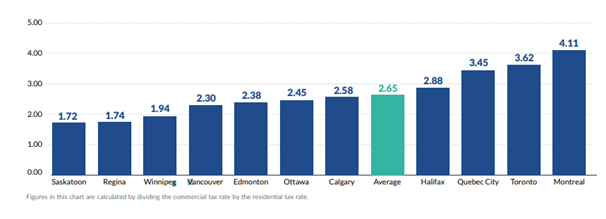
Remember, both Calgary and Vancouver now has a below-average national tax rate. On the other side, Montreal has had the biggest increase in commercial-to-residential tax ratio of 4.5%, while Quebec City saw an above-average increase of 3.45.
From Toronto to Montreal to Vancouver: Key Benchmarks and Rates
In Vancouver, the current benchmark price for homes stands at 13.7%. In Toronto, the average price to sell detached homes is 23.1%. As of now, the Canadian real estate landscape has become a paradise for sellers. Despite economic distress and pandemic crisis, Vancouver and Toronto continue to build modest housing projects. In most neighborhoods, there is a record sale of houses during the pandemic.
Although Vancouver homes come with an expensive price tag, the city had the lowest tax rate in 2020. Typically, Canadian major cities like Toronto and Vancouver now have high property value with a low tax rate. Conversely, Winnipeg and respective cities have low property values with high tax rates. Despite disparities throughout major cities of Canada, property tax rates have managed to triple for homeowners in Vancouver.
In 2020, the 5 major Canadian cities with the biggest commercial property taxes for $1,000 assessed value include:
- Quebec City: $35.03
- Montreal: $36.99
- Ottawa: $26.64
- Halifax: $34.41
- Winnipeg: $23.17
The 3 Canadian cities with the lowest commercial-based tax rate include:
- Vancouver: $6.73
- Saskatoon: $15.65
- Regina: $17.31
It is true – Vancouver’s commercial tax rate was more dynamic in 2019. The reduced change in Vancouver’s commercial rate represents a critical realization of real estate developers, owners, and managers.
Calgary and Vancouver also had low commercial tax rates by almost 12% in 2020. Real estate experts believe that these cities can no longer afford high commercial tax rates. In the near future, decreased commercial rates and high residential rates may become a cause of concern.
But residential tax rates have been mostly unchanged in 2020. In fact, the average residential real estate property tax as per assessed $1,000 comes down to $8.98. In comparison, it’s just a penny less than the previous year.
In terms of residential property, Halifax had the highest taxes in 2020. Similarly, Winnipeg and Ottawa had the second and thirst highest residential taxes in 2020. But Toronto and Vancouver had the lowest residential tax rates in 2020.
Historical Tax Rate Pattern: Case Study
Between 2016 and 2017, Edmonton and Calgary had unprecedented high property tax rates. And that’s because provincial municipalities managed to offset the overall impact of home prices. At the same time, Toronto and Vancouver had reduced property tax by 14% for straight 9 years.
In fact, it is the main reason there is more property value in Calgary is lower than in other cities in Canada. For the past few years, research reports also point out that Ottawa, Halifax, and Winnipeg continue to record high tax rates that render more value for real estate properties.
Property Tax in Canada: Current and Future Trends
While the post-early-pandemic period saw a surge in Canada's real estate market with high demand, the situation in 2024 and early 2025 has shifted.
Higher interest rates implemented since 2022 have significantly impacted affordability and market activity, moving away from the "supercharged" growth previously observed.
According to the Canadian Real Estate Association (CREA), national home sales saw declines in early 2025, with the national average price also down year-over-year in March 2025 compared to March 2024.
The condo and rental markets are also seeing adjustments. Data from Rentals.ca and Urbanation indicates that average asking rents across Canada saw declines towards the end of 2024 and into early 2025, a notable change from the strong rent growth in preceding years.
This moderation is partly attributed to increased rental supply from new construction and potentially a slowdown in population growth compared to recent peaks, as noted by CMHC.
While demand remains, the market is becoming more balanced in some areas, particularly in the condo segment where new completions are adding inventory. Regional variations persist, with some markets still experiencing price growth while others see declines, reflecting a more complex landscape than the broad surge anticipated in the 2021 outlook.
Expectations for the remainder of 2025 are cautiously optimistic, with potential interest rate adjustments possibly influencing activity, but affordability and supply levels remain critical factors shaping the market.
Conclusion
It would be fair to state that Canada’s property tax laws are progressive. In fact, it is flexible and straightforward to acquire a real estate property in Canada. Since interest expenses and property taxes are deductible, you don’t have to reside in Canada or become a citizen. There are more than enough tax benefits to make profitable real estate investments in Canada.
Some rationalization can be expected in the commercial property tax regime in major cities. Residential rates are expected to remain mostly unchanged.
It should also be noted that property tax assessment is hugely affected by the property ownership structure.
Hope you enjoyed this article on property tax in Canada. If you have any feedback on property tax, please let me know in the comment section below.
FAQ
Are property taxes high in Canada?
Cities like Fredericton and Winnipeg, as well as other cities with low house prices, have some of the highest tax rates, while cities like Vancouver and Toronto have high home values and cheap property taxes. Nevertheless, there is a large gap in the results of the various cities.
Which city in Canada has the lowest property taxes?
The property tax rate in Vancouver is the lowest in all of British Columbia at 0.24683 %, which is exactly half of the rate in Abbotsford, which is 0.51300 %. In general, the cities located inside British Columbia rank among those with the lowest property rates.
How often do you pay property tax in Canada?
YEARLY - If you own or rent a property or manufactured home in B.C., you must pay property taxes on each property every year. During the COVID-19 pandemic, here are some important facts about property taxes: The due dates for rural property taxes have not changed.
How is the annual property tax calculated in Canada?
Annual property tax in Canada is based on two critical factors: the property value and the residential rate. It is imposed by the local government.
Can non-residents buy or own property in Canada?
Non-residents in Canada can buy or own property, including rental property. These individuals have to file their annual tax returns with the CRA.