

Understanding Market Feasibility Study in Real Estate Development
A market feasibility study is conducted to validate if the target real estate market could support the development.
Before starting a new development or redevelopment project it is essential to complete a proper evaluation of the local market conditions and demand drivers. A market feasibility study can include the below sections:
Overview of the project
Articulate a concise project description. What type of development is it (residential, commercial, mixed-use)? Who is your target audience? What are the key features and unique selling propositions? This clarity will inform every subsequent step of your study.
Economic Overview of the Area
- General Overview: Analyze the overall economic climate. Is the area experiencing growth, stability, or decline? Look at historical trends and future projections to gauge the general economic trajectory.
- Gross Domestic Product: Research the region's GDP growth rate. A healthy GDP often signals increased business activity and consumer spending, positively impacting real estate.
- Investment Indicators: Identify key investment trends. Are businesses expanding? Is there significant infrastructure development planned? Increased investment often fuels job creation and demand for housing and commercial spaces.
- Inflation: Analyze historical and projected inflation rates. High inflation can impact construction costs, property values, and rental affordability. Understanding these trends is crucial for accurate financial forecasting.
- Population and labor: Delve into population demographics. Is the population growing? What's the age and income distribution? What are the employment rates and the strength of the labor force? Growing populations and strong job markets are key drivers of real estate demand.
- Tourism: If relevant to your project, analyze tourism trends. How many visitors does the area attract? What are their spending habits? Growth in tourism can significantly impact specific real estate sectors.
- Any other thing relevant to that location and project
Site and Location Analysis
- Site and Location Overview: Assess the physical characteristics of your site. Consider its size, topography, environmental factors, and existing infrastructure (utilities, access roads).
- Location Assessment and Accessibility: Evaluate how accessible the site is. Are there good transportation links (roads, public transit)? What are commute times to key employment centers and amenities? Accessibility significantly impacts the attractiveness and value of your development.
- The Location of the Project within the City: Understand how your project fits into the existing urban fabric. What are the surrounding land uses? What is the neighborhood character? Are there any future development plans for the area that could impact your project? Review zoning regulations and local development plans.
- SWOT Analysis of the Project Site: Conduct a SWOT analysis specifically for your site. What are its Strengths? What are its Weaknesses? What Opportunities exist? What are the potential Threats?
Market Assessment
- Supply, Demand and Projected Absorption: Analyze the existing supply of comparable properties in the market. What is the current demand? What is the rate at which new properties are being absorbed (sold or leased)? Project future absorption rates based on historical trends, economic forecasts, and demographic shifts.
- Development Concept and Market Fit Analysis: Ensure your proposed development concept aligns with the identified market demand and the needs of your target audience. Does your product offering resonate with what the market is currently seeking?
- Product Mix Overview: Determine the optimal mix of units or product types within your development. This should be driven by your understanding of the target market.
- Product Positioning: Define how your project will be positioned relative to its competitors. Will it be a luxury offering, a mid-range option, or an affordable development? What will be its unique selling proposition (USP)?
- Competitive Position of Project Site: Analyze existing and planned competitive projects in the immediate vicinity of your site. Compare their features, pricing, target markets, and absorption rates. Understanding your competitive landscape is crucial for differentiation.
Operation
- Operator Decision: Decide whether you will self-operate the property or hire a professional management company. Consider factors like your expertise, the scale of the project, and the desired level of involvement. Weigh the pros and cons of each approach.
- Staffing Issues: If you plan to operate the property, develop a preliminary staffing plan. Consider the number and types of staff you'll need, recruitment strategies, and potential labor costs in the local market.
- Various Operating Model: Explore different operating models relevant to your project type. Understand the implications of each model for management and profitability.
- Maintenance Issues: Plan for ongoing maintenance and potential costs. Consider the long-term maintenance implications of your design choices and material selections.
- Other Operational Issues: Think proactively about other operational aspects such as security, marketing and leasing strategies, and tenant or customer relations.
Financial Analysis
- Supply, Demand and Projected Absorption: Remember that your projections for supply, demand, and absorption directly underpin your revenue forecasts. Realistic market analysis is crucial for accurate financial modeling.
- Pricing Strategy: Develop a detailed pricing strategy based on your market analysis, competitive positioning, and target profit margins. Consider different pricing scenarios and their potential impact on absorption rates.
- Estimated Required Investment (land cost, development cost, financing cost etc.)
- Unleveraged IRR or Project IRR: Calculate the Unleveraged Internal Rate of Return (IRR), which represents the project's inherent profitability without considering debt financing. This helps you assess the fundamental viability of the development.
- Leveraged IRR and Funding Strategy: Analyze the Leveraged IRR, which incorporates the impact of debt financing on your return on equity. Develop a clear funding strategy, outlining your intended sources of capital (equity, debt). Explore different financing options and their implications for your returns.
- Various Financial Performance Indicators: Evaluate other key financial metrics such as Net Present Value (NPV), cash flow projections, Return on Equity (ROE), and break-even analysis to gain a holistic view of the project's financial viability.
- Scenario Analysis: Conduct scenario analysis to assess how the project's financial performance might be affected by different potential market conditions (e.g., slower absorption, lower rental rates, increased construction costs). Identify key variables to test.
- Sensitivity Analysis: Perform sensitivity analysis to determine how changes in a single critical variable impact the project's financial outcomes. This helps you identify the most significant risk factors.
If you are new to the market feasibility study, you should have look at the process of conducting the market feasibility study.
I have also covered site analysis for market feasibility study in detail previously
Since 2019, the real estate market in Canada has been fire despite the Covid-19 pandemic. Buoyed by the influx of immigrants, increasing employment and income, the rebound is expected to continue for a few more years. For real estate developers, this is music to the ears. Simply put, there has never been a better time for a new real estate development.
However, caution must be exercised, a proper market feasibility study must be carried out by prospective or even established real estate developers, before proceeding to invest in a new property developments or re-development.
In this post, I will be examining the following topics
- What is a market feasibility study
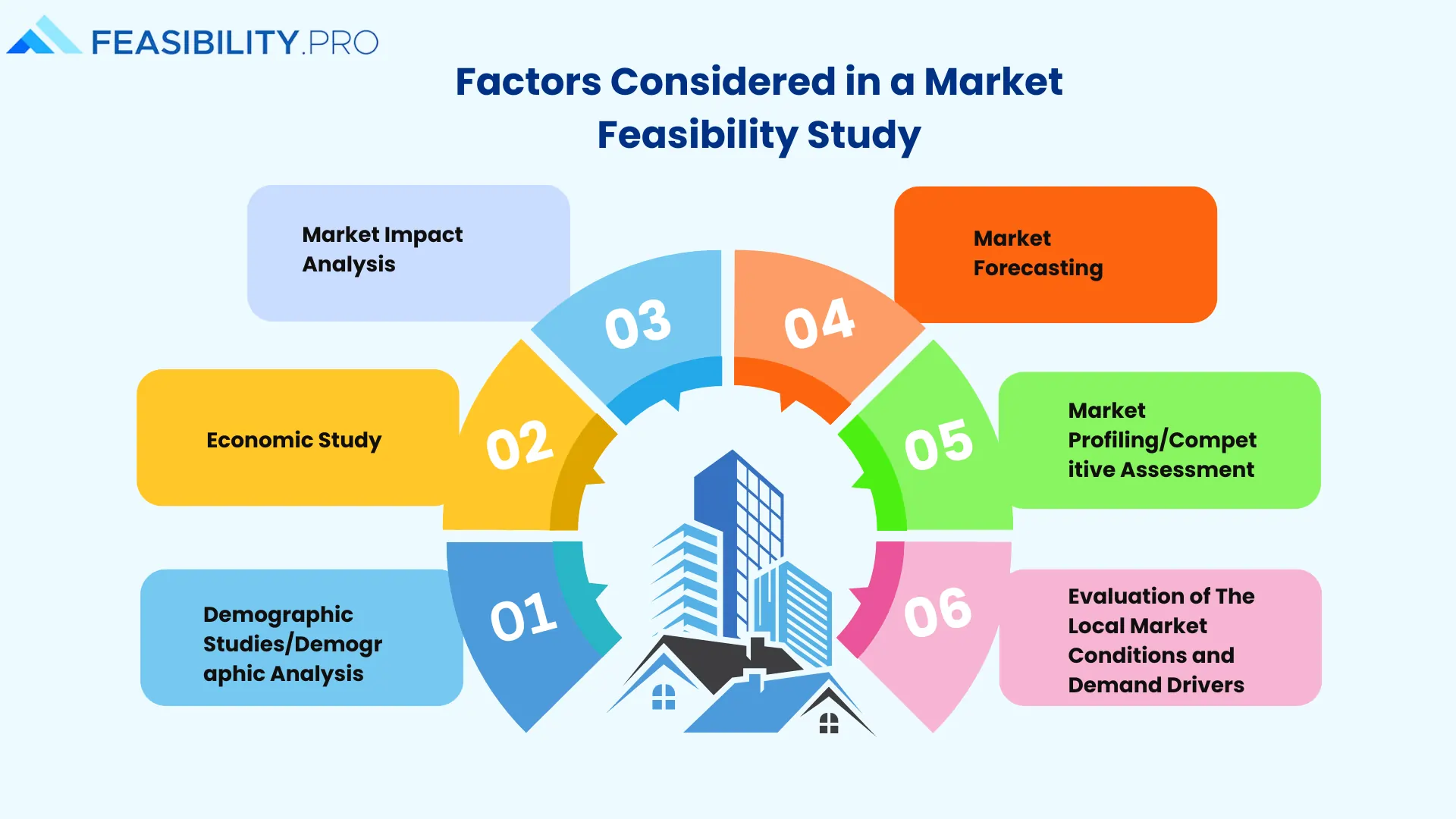
- What are the factors considered in a market feasibility study?
- How to conduct a market feasibility study?
- The benefits of conducting a market feasibility study
What is a market feasibility study?
Simply put, a market feasibility study or property feasibility study is a study used to analyze the real estate markets in specific locations, to determine the viability of proposed property developments. Several factors may determine the profitability of real estate projects. Market feasibility study allow developers to assess these factors and how they can affect the project.
Developers can come up with any kind of development vision. And, regardless of the excellence of such vision, where the necessary factors are not considered, real estate developments tend to get wound up in a myriad of problems, ranging from marketability problems to legal issues. To help you avoid such pitfalls, I have written this article to highlight how to conduct market feasibility study for real estate developments and the factors to watch out for.
Read More About: Real Estate Development Feasibility Study: The Ultimate Guide

What are the Factors Considered in a Market Feasibility Study?
Below, I list and explain the categories of factors that must be considered in a market feasibility study before the sod is cut on any real estate development project. I have already covered the extensive list at the start of the article but will explain some of them in detail.
Demographic Studies/Demographic Analysis
Demographic data is a huge determinant of the profitability of any real estate development. Before you decide on what type of real estate to develop, you must study the demographics of the intended area of the build. Demographic data includes:
- Income level
- Household size
- Age of the population
Let us examine this scenario - Mr. George and Ms. Phillipa are both real estate developers based in Alberta and Yukon respectively. They both devote similar investments to building similar luxury condos and execute similar marketing strategies. However, they do not achieve a similar level of financial return. Why could that be?
Mr. George’s condos are in Alberta with a much higher population of high-income earners, compared to Yukon, and thus had not much trouble finding willing buyers. However, with a low population of high-income earners in Yukon, Ms. Phillipa’s luxury condos remained largely unsold. This is an example of how these factors affect the performance of real estate developments.
Had Ms. Phillipa conducted a market feasibility study, she would have realized that building low-cost affordable housing was better suited for her market and more economically viable than luxury condos.
Economic Study
The most paramount concern of every business is profitability. The economics of a project focuses on the costs and affordability of its development, the financial instruments that would be used to fund it, and the ease of assessing them. Also, the projected profit margins are examined.
Real estate developments must be economically viable. Real estate is expensive to build and maintain, economic viability ensures the continuity and completion of the project.
Market Impact Analysis
Another particularly important component of the real estate market feasibility study is the market impact analysis. Here, the potential impact of the project on the local market of the location of the proposed development is studied.
This analysis is especially crucial for legal reasons. Different municipalities have different laws for preserving their neighborhoods. Conducting market impact analysis will help you to identify whether your project falls short of the laws in place. With this information, you may decide to alter the project to fit in or to pivot completely.
Market Forecasting
Market forecasting is another vital component of a market feasibility study. Often, markets change, and variables shift. However, these situations can be mitigated by a thoughtful real estate developer.
Market forecasting is especially vital because it helps you to determine whether the project will remain viable in the future. To do this, you must study varying factors; geographical, political, legal factors, to determine the future of the market.
For example, developing a gentrifying area is bound to bring you much profit whereas properties built in areas prone to the adverse effects of climate change are bound to lose value along the line.
Market Profiling/Competitive Assessment
This aspect entails analyzing the existing market and your would-be competitors. You must comprehensively analyze the current position of the market and the developments of your competitors to determine what sub-segments of the market may be saturated or maybe under-served. Also, market profiling will help you identify what types of real estate are in high demand in the area.
Consider the following scenario. Mr. Jack intends to build apartment complexes in Ontario. Ordinarily, apartment complexes usually get quickly sold out, because of their affordability and practicability for people living alone and small, lower-middle-class families. So, it is a no-brainer, right?
Well, not so much. Conducting market profiling and competitive assessment will show him that the customers in Ontario are beginning to want more square footage and privacy consistent with stand-alone houses or terrace apartments. And competitive assessment will show him that the apartment complex market is saturated, and the terrace apartment market is underserved.
Armed with this information, he may now decide to plan an entirely new development or move to a new location where he will be more likely to earn profits from the development.
Evaluation of The Local Market Conditions and Demand Drivers
The final component of the market feasibility study is the evaluation of the local market conditions and the factors that drive demand. Most importantly, you want to find out the average rent and average property sale prices and, how much people are willing to spend on the real estate.
However, market conditions are not strictly economic, you may also want to research the cultural and political factors that may dictate the preferred sub-locations
How to Conduct a Market Feasibility Study
Now that we have robustly outlined all the components of a market feasibility study, how do you conduct it? Well, all you need to do is follow the three steps outlined below.
- Define your development vision
- Gather and analyze the facts
- Re-evaluate your project
Define Your Development Vision
The first thing you want to do is to define your development vision.
- What do you want to build?
- Why do you want to build it?
- Who are your projected buyers and/or renters?
When you have a clear vision of your project, you can easily understand how the factors you will be considering may affect the development.
Gather and Analyze the Facts
We have outlined all the important factors above and why they matter. Gather all the facts related to your project. You may do this either by carrying out surveys, interviews, or researching public records.
Then, analyze the information and find out how they all affect your development, whether positively or negatively.
Re-evaluate Your Project
Finally, re-evaluate your project. You might have to make a few minor changes, make a complete pivot, or even bring the project to a full stop altogether
You May Also Like To Read: 8 Common Mistakes in Real Estate Feasibility Studies Made by Developers
The Benefits of Conducting a Market Feasibility Study
Conducting a feasibility study is not just another mundane or routine procedure associated with starting a real estate project. It presents several benefits, all of which contribute to helping you to make the right decisions, for profitability and viability. Some of these feasibility benefits are listed below.
- Conducting a market feasibility study helps you to test your development vision for viability. It is not enough to have the financial and human resources to execute a project, it first must be workable. Market feasibility study is a straightforward way to evaluate workability.
- It helps to improve the team’s confidence and focus. It is easy to get disenchanted with ambitious development projects. However, a market feasibility study may help to bolster confidence by proving the project’s viability.
- It helps you to accurately assess the project needs. Real estate requires a lot of resources, ranging from financial resources to human resources and technical know-how. Conducting a market feasibility study helps you to fully assess the specific resources required by the project.
Conducting a market feasibility study is not for show, but for results. Real estate developments are only lucrative when the clients are willing and able to splash the cash on your project.
Everyone makes mistake and a real estate development analyst is no exception. We should always follow the best practices of creating a real estate market feasibility study model and should avoid these top 10 mistakes at all costs.
Check the market feasibility study template in this post, and if you are looking for real-life samples of market feasibility study, look no further – I have got it covered it as well.
Hope you enjoyed this post on market feasibility study, let me know what you think in the comment section below.
How to do a Market Feasibility Study How to do a Market Feasibility Study
FAQs
What is the importance of conducting a market feasibility study?
Importance of conducting a market feasibility study ? Simply said, a market analysis is a need or a worthwhile endeavour. Based on a project's competitive position in a specific industry, as well as its potential demand in that market, this analysis provides a third-party perspective for a given project.
What should a market feasibility study include?
What Elements Should Be Components of a Market Feasibility Study? A description of the industry, a study of the present market, an examination of the competition, an estimation of the potential of the future market, prospective sources of income, and sales estimates should all be included in market feasibility studies.
How do you conduct a market feasibility study for a new real estate development?
Define your vision, gather and analyze relevant facts (demographics, economy, etc.), and then re-evaluate your project based on the findings.
What are the benefits of performing a market feasibility study before investing in real estate development?
It tests viability, improves team confidence, accurately assesses needs, and ultimately helps ensure more profitable real estate developments by aligning with market demand.










Thank you . We really appreciate your gracious works for the benefit for those who cannot afford to do a feasibility. God bless your work and yourself.
It is nice work continue please