
FAR vs GFA vs BUA
In any real estate project — whether residential, commercial, or mixed-use — accurate spatial planning is essential. Understanding the development capacity of land requires a firm grasp of three fundamental metrics: FAR (Floor Area Ratio), GFA (Gross Floor Area), and BUA (Built-Up Area). These metrics not only dictate what is legally permissible but also influence cost estimation, marketable area, and return on investment.
Read More About: Real Estate Development Feasibility Study: The Ultimate Guide
Definitions and Practical Meanings
FAR – Floor Area Ratio
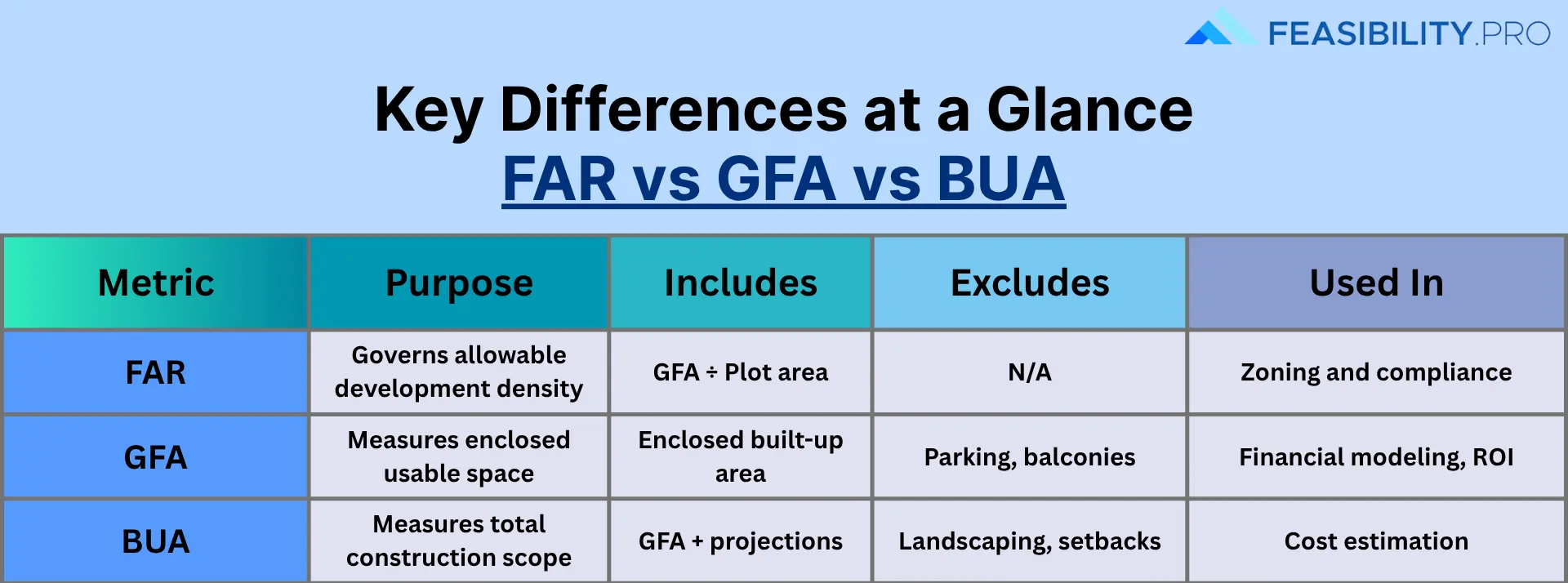
FAR is a zoning tool used by urban planning authorities to regulate density. It is calculated by dividing the total gross floor area of a building by the total land area.
Formula:
FAR = Gross Floor Area / Plot Area
Example:
For a plot of 1,000 sqm with a permitted FAR of 2.5, the maximum allowed GFA is 2,500 sqm.
Planning Implication:
FAR governs the development envelope. Exceeding it typically requires regulatory exemptions or variances.
GFA – Gross Floor Area
GFA represents the sum of all enclosed spaces across all floors of a building. This includes internal corridors, staircases, lifts, and utility rooms.
Definitions vary slightly by jurisdiction, but in general:
Included in GFA:
- Covered internal floor space
- Service shafts and vertical ducts
- Common lobbies and internal walls
Excluded from GFA (in many regions):
- Balconies
- Parking structures
- Open terraces and setbacks
BUA – Built-Up Area
BUA extends beyond GFA to include all constructed areas, both usable and non-usable. It includes balconies, external walls, and utility projections. This metric is primarily used for calculating construction costs and saleable area (in certain countries).
BUA = GFA + Balconies + External walls + Utility shafts
Suggested Visual: 3-Layer Building Overlay
- Layer 1 (inner core): GFA
- Layer 2: BUA (includes balconies and projections)
- Layer 3: FAR envelope overlaid on site plan
Read a Sample Feasibility Study
Common Mistakes in Application
- Misclassifying balconies as part of GFA
Depending on the municipality, balconies may or may not count toward GFA, which affects FAR compliance and pricing models. - Using BUA in place of GFA when calculating saleable area
This inflates revenue expectations and can mislead project stakeholders or investors. - Assuming global definitions apply locally
Regulations differ drastically between cities like Dubai, Toronto, and Singapore. Developers must consult local codes. - Ignoring the impact of circulation space
Corridors, stairwells, and lift lobbies are typically included in GFA but not in the saleable area, impacting feasibility outcomes.
Application in Real Estate Feasibility Studies
Why These Metrics Matter:
- FAR determines if the project complies with municipal zoning and impacts maximum development yield.
- GFA affects project revenue: the more efficient the layout, the more sellable or leasable space.
- BUA influences construction costs, including materials, labor, and time.
Scenario Example:
- Plot size: 2,000 sqm
- Permitted FAR: 2.0 → Max GFA: 4,000 sqm
- Estimated BUA: 4,800 sqm (including balconies and service areas)
- Circulation factor: 25% → Net saleable area: ~3,000 sqm
Incorrect assumptions here can lead to misleading cash flow projections, IRR, and ROI
You May Also Like to Read: Site Analysis for Real Estate Developments + Case Study
How Feasibility.pro Simplifies These Calculations
Feasibility.pro eliminates ambiguity by integrating zoning regulations, calculation logic, and financial modeling into one platform.
With the SF (Standard Feasibility) Module:
- Developers can input plot size, zoning code, and land constraints
- The system calculates maximum FAR, allowed GFA, and estimated BUA
- Automated financial outputs reflect real-world constraints
Users can test what-if scenarios with different development mixes
Final Insights
Understanding the technical nuances of FAR, GFA, and BUA is essential for every stakeholder in real estate development—from urban planners and architects to financial analysts and junior consultants.
Getting these metrics right enables:
- Accurate cost forecasting
- Efficient space planning
- Legal compliance
- Higher investor confidence
Get started with a free trial today.
Feasibility.pro enables developers and consultants to model projects with real-time precision—no more second-guessing or spreadsheet gymnastics.
Run your next feasibility study using data-backed FAR, GFA, and BUA logic.