EstateMaster vs Feasibility.pro
In the dynamic real estate sector, accurate financial feasibility analysis is fundamental for strategic decision-making, risk mitigation, and optimizing returns. These studies assess a project's viability, practicality, and economic potential. Modern real estate ventures, however, demand sophisticated software tools beyond traditional manual methods like spreadsheets due to their complexity.
Real estate feasibility software has evolved from simple calculators to comprehensive decision-support systems. Professionals now require predictive analytics, risk modeling, and clear presentation capabilities to navigate intricate market conditions. Specialized solutions such as Altus Group's ARGUS EstateMaster and Feasibility.pro underscore this demand for deeper analytical power and faster processing, making them integral to strategic planning, not just operational execution. This report will compare these two prominent platforms, detailing their functionalities, target users, and benefits to align with specific business objectives.
Read More About: What is a Property Feasibility Study?
ARGUS EstateMaster: A Legacy of Robust Analysis
ARGUS EstateMaster, a flagship product from Altus Group, stands as a long-established and highly respected solution within the global real estate sector. With a proven track record spanning over two decades, it has solidified its position as a reliable and comprehensive tool, designed to support professionals through the entire property development and investment lifecycle. Its longevity speaks to its adaptability and adherence to industry best practices.
Key Modules and Functionalities
EstateMaster offers a modular suite designed to address various stages of a real estate project:
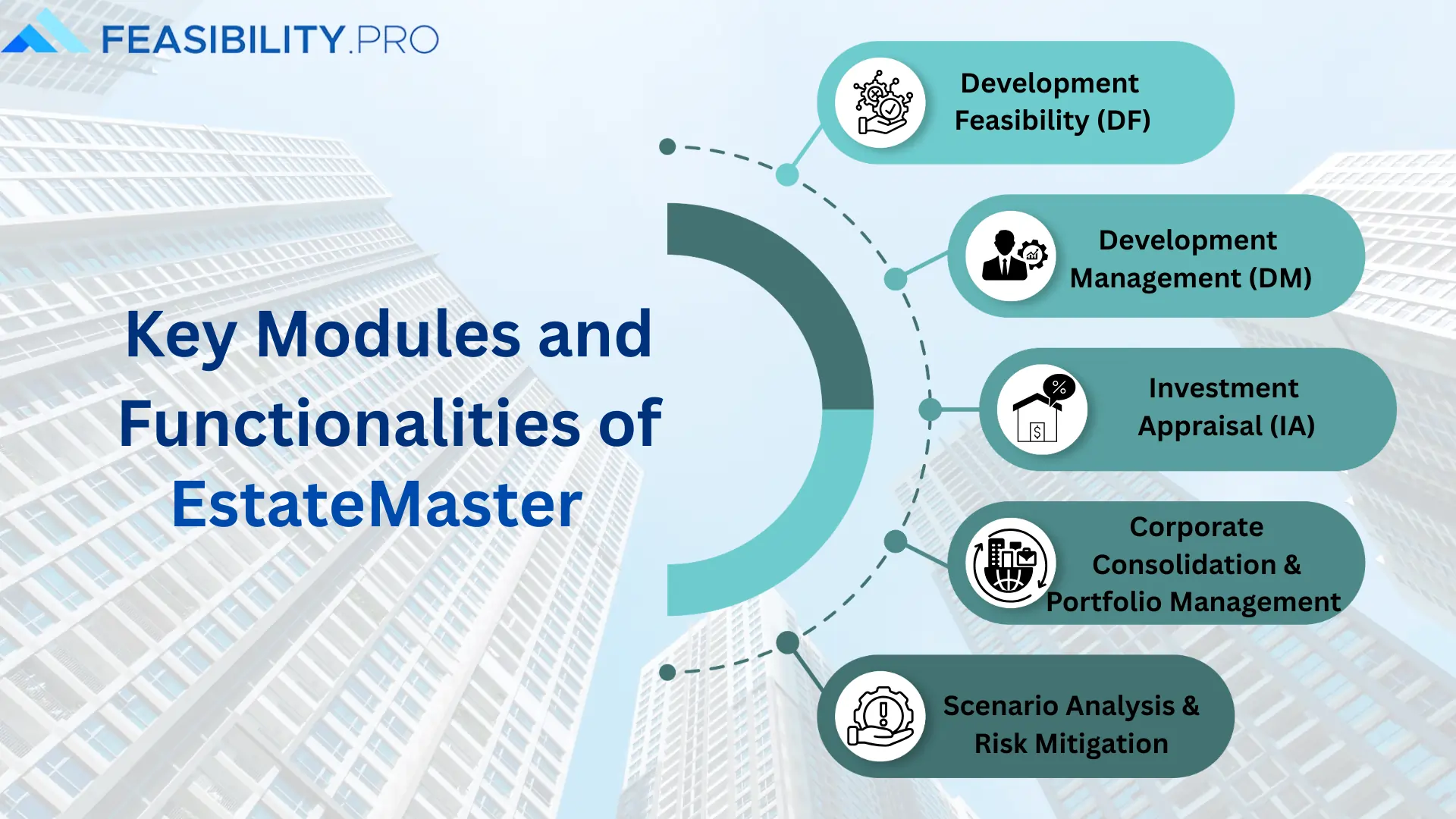
Development Feasibility (DF): This core module is instrumental for appraising new development opportunities. It meticulously calculates crucial financial performance indicators such as Profit Margin, Residual Land Value, Net Present Value (NPV), and Internal Rate of Return (IRR) with high accuracy. EstateMaster DF supports a wide array of project types, including land subdivision, residential, commercial, retail, industrial, build-to-sell, and build-to-rent.
Development Management (DM): Moving beyond initial appraisal, DM is tailored for the active management phase of development projects. It enables users to track actual costs and revenues against initial feasibility estimates, providing real-time monitoring of a project's financial performance and facilitating necessary adjustments.
Investment Appraisal (IA): This module assists investors and developers in rigorously evaluating the financial viability of various property investments. It analyzes investment returns, cash flows, and valuations, employing both discounted cash flow (DCF) and income capitalization techniques. Notably, it is capable of forecasting rental cash flow for up to 40 years, catering to long-term investment analysis.
Corporate Consolidation (CC) & Portfolio Management (PM): For larger enterprises, EstateMaster offers advanced capabilities to merge both feasibility and management cash flows. This allows for tracking multi-stage developments or consolidating company-wide portfolios, enabling sophisticated business planning, multi-currency reporting for global projects, and comprehensive financial reporting across an entire portfolio.
Scenario Analysis & Risk Mitigation: EstateMaster provides robust tools for sensitivity and probability analysis. Users can test the impact of changes in key variables—such as construction costs, sales values, or interest rates—on project returns. A notable capability is its ability to run up to 2,000 simulations to derive probability profiles for development margin and IRR, offering a deeper quantitative understanding of risk. It also allows for side-by-side comparison of up to eight different development scenarios or project stages.
Target Users and Core Benefits
EstateMaster is ideally suited for a broad spectrum of real estate professionals, including property developers, investors, valuers, appraisers, consultants, and financiers. Its primary benefits include ensuring consistency, transparency, and efficiency throughout the analysis and reporting processes. By facilitating critical business intelligence, it helps organizations save time and money while effectively mitigating project risks.
The comprehensive nature of its modules, particularly Development Management, Investment Appraisal, and Portfolio Management, indicates its design as an end-to-end solution for the entire property lifecycle, extending beyond initial feasibility.
This suggests a deeper integration into the operational and strategic layers of large real estate organizations, positioning EstateMaster as an enterprise resource planning (ERP)-like tool for real estate, capable of managing financial aspects from conception through completion and portfolio oversight.
This makes it particularly attractive to large, diversified real estate firms that require a single, integrated system for their entire operational and investment pipeline, rather than just a specialized feasibility calculator.
You May Also Like to Read: Site Analysis for Real Estate Developments + Case Study
Feasibility.pro: The Next-Generation Approach
Feasibility.pro positions itself as a "next-generation" real estate feasibility software, emphasizing a modern, agile approach to property development analysis. It aims to empower developers and investors with powerful, intuitive tools that prioritize speed, efficiency, and specialized analytical capabilities.
Key Modules and Functionalities
Feasibility.pro offers distinct modules tailored to specific project needs:
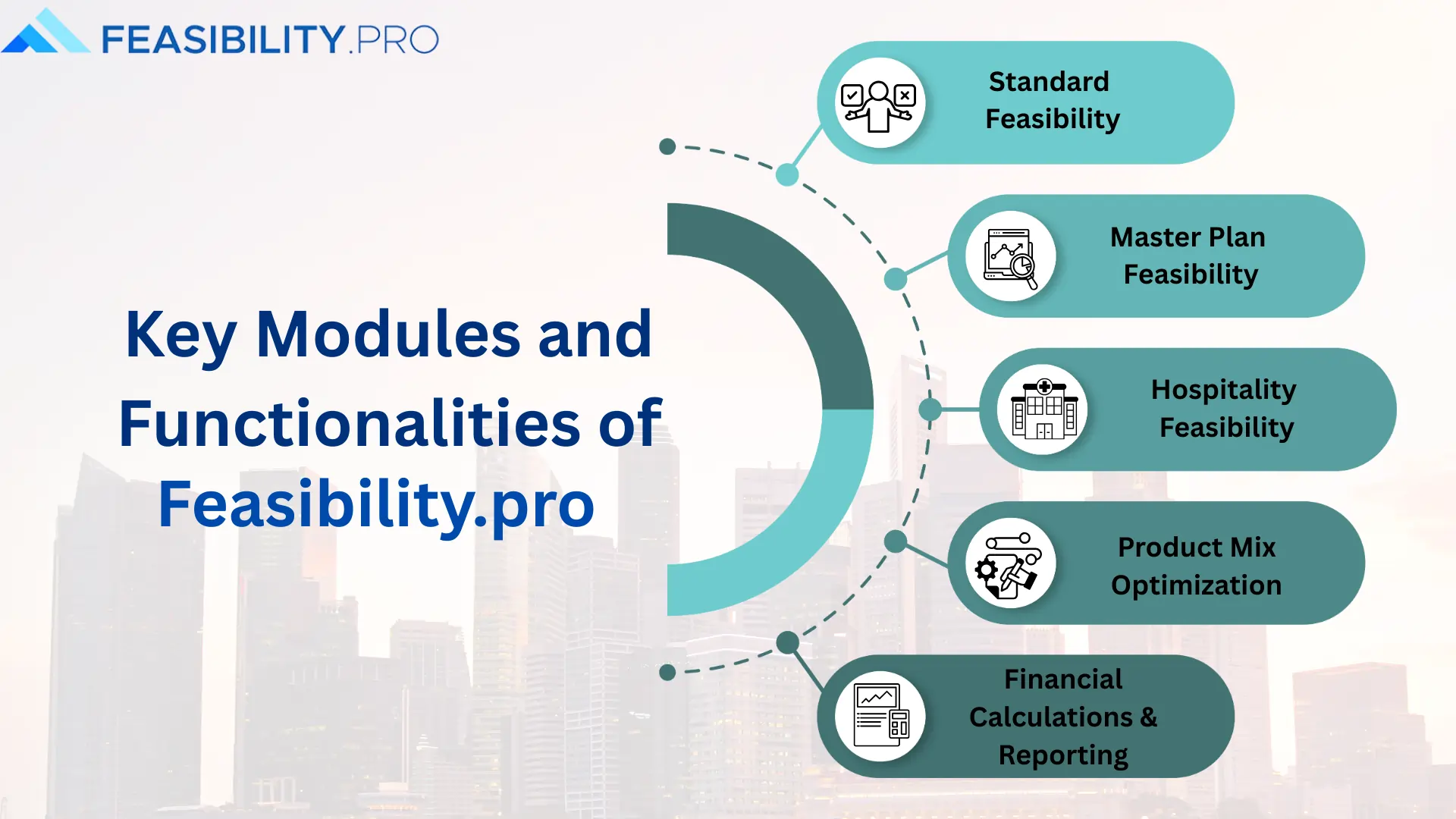
Standard Feasibility: This module is tailored for plot-level residential developers, offering a streamlined and quick approach to project modeling. It instantly calculates essential KPIs such as IRR, NPV, ROI, and residual land value, and includes robust sensitivity analysis. Users can conveniently save and compare up to eight different project options.
Master Plan Feasibility: A standout feature, this module is described as the "world's first comprehensive master plan feasibility module." It is specifically designed for large, multi-phased, or township-scale developments, enabling granular analysis by product type, development phase, or land use, and includes sophisticated cost allocation mechanisms.
Hospitality Feasibility: This specialized module caters to branded and independent hotel projects. It uniquely incorporates the USALI (Uniform System of Accounts for the Lodging Industry) standard P&L, providing industry-specific financial reporting and analysis for hotel developments.
Product Mix Optimization: This module serves as a powerful tool for mixed-use and master developers. It helps optimize built-up ratios and unit mixes to achieve maximum profitability, offering a comprehensive approach for highest and best use analysis.
Financial Calculations & Reporting: Beyond calculations, Feasibility.pro generates outputs that are easy to understand and ready for presentation. Users can generate reports for stakeholders with a single click, manage detailed project cash flows with confidence, and assess risk effectively with automatic sensitivity analysis on every project.
Target Users and Core Benefits
Feasibility.pro is trusted by and designed for a diverse group, including developers, analysts, and, notably, "Future Real Estate Leaders" (students and faculty). Its primary benefits revolve around enabling users to analyze deals with confidence, save significant hours on modeling by "eliminating Excel chaos," and make swift, data-driven decisions based on instant access to KPIs and sensitivity scenarios. The platform boldly claims to operate "30% faster than any other industry software".
The strategic focus on "world's first" specialized modules, such as the Master Plan module and the Hospitality module with USALI P&L, indicates a deliberate move by Feasibility.pro to carve out a niche by offering highly granular and industry-specific analysis for complex, modern development types. This suggests a competitive advantage in these particular sectors, appealing to firms with specialized portfolios.
This specialization implies that Feasibility.pro is not merely a general feasibility tool but aims to be a best-in-class solution for these intricate development types. This strategy allows it to differentiate itself from broader, older platforms by offering unparalleled depth and industry-specific relevance in these key areas, potentially attracting developers who specialize in or frequently undertake such complex projects.
You May Also Like to Read: Real Estate Development Feasibility Study: The Ultimate Guide
A Clear Comparission: ARGUS EstateMaster vs Feasibility.pro
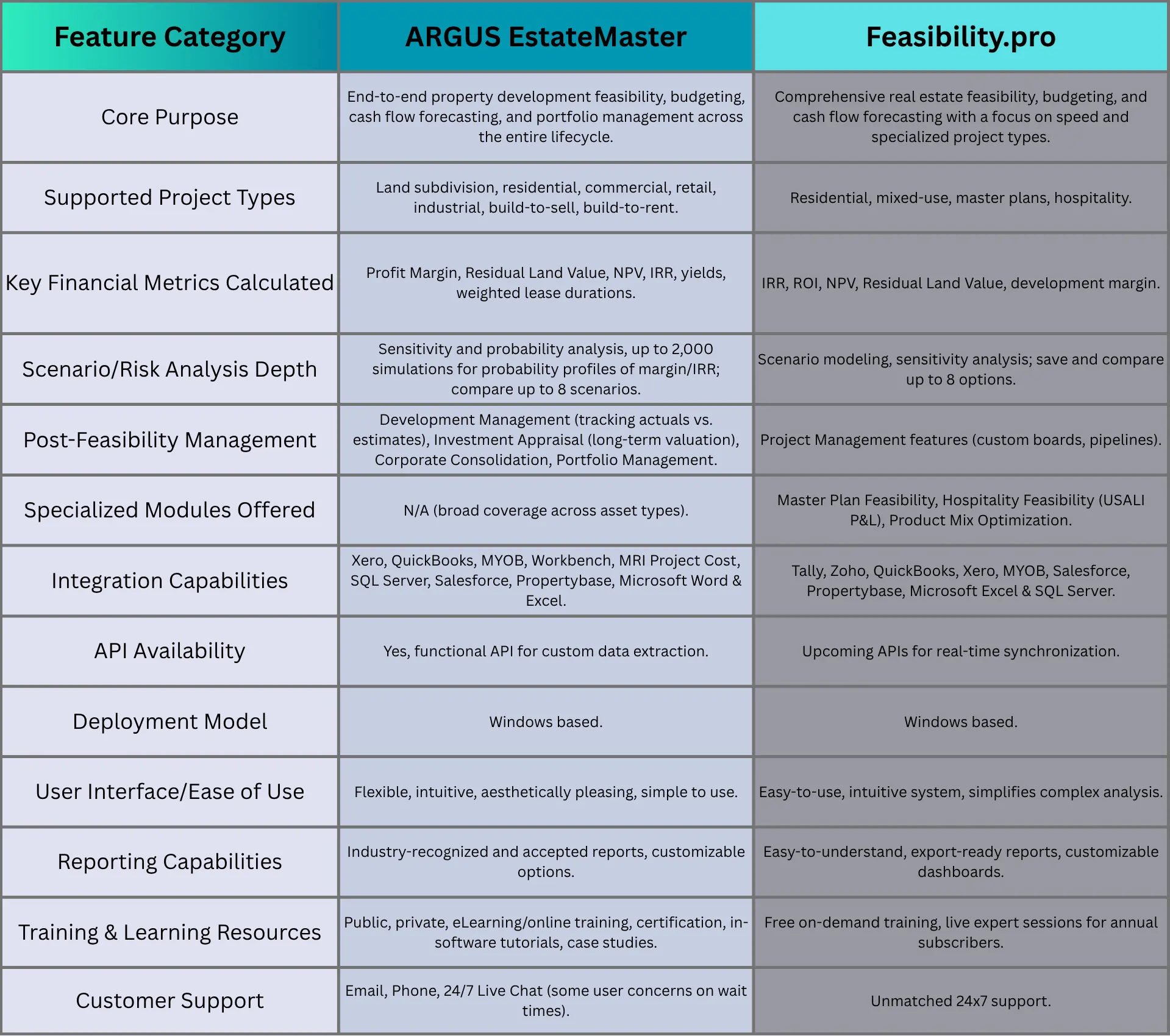
Side-by-side comparison of the two software solutions across key operational and functional dimensions.
Project Types & Financial Modeling
ARGUS EstateMaster offers broad support for a wide spectrum of project types, encompassing traditional land subdivision, diverse residential formats, and various commercial, retail, and industrial developments, including build-to-sell and build-to-rent models. Its financial engine precisely quantifies critical KPIs like Profit Margin, Residual Land Value, NPV, and IRR. The Investment Appraisal module stands out with its capability to forecast rental cash flows for extensive periods, up to 40 years, catering to long-term investment analysis.
Feasibility.pro provides comprehensive support for a focused range of project types, including residential, mixed-use, master plans, and hospitality developments. It delivers instant calculations of key financial metrics such as IRR, ROI, NPV, and Residual Land Value. Its strength lies in its specialized modules, particularly the Master Plan Feasibility and Hospitality Feasibility (which includes USALI P&L), offering highly tailored and granular analysis for these complex and niche sectors.
Scenario Analysis & Risk Mitigation
ARGUS EstateMaster offers robust capabilities for sensitivity and probability analysis. Users can thoroughly test the impact of changes in various financial and operational variables, such as construction costs, sales values, rents, and interest rates, on their project returns. A key differentiator is its ability to run up to 2,000 simulations to generate probability profiles for development margin and IRR, providing a sophisticated quantitative assessment of risk. It also facilitates direct comparison of up to eight different scenarios or project stages side-by-side.
Feasibility.pro enables users to perform comprehensive scenario modeling to analyze different possibilities and conduct sensitivity analysis to effectively manage development risk. Similar to EstateMaster, it allows for saving and comparing up to eight different options, aiding in the identification of optimal outcomes.
Integration & Scalability
ARGUS EstateMaster offers robust integration capabilities with a range of third-party applications. It seamlessly connects with various accounting systems, including Xero, Intuit QuickBooks, MYOB, Workbench, MRI Project Cost, and SQL Server. For sales and customer relationship management, it integrates with Salesforce, Propertybase, and SQL Server. Additionally, it supports integration with Microsoft Word and Excel for data exchange. Crucially, EstateMaster does have an API available, enabling custom data extraction into other business intelligence tools via middleware. The software is described as adaptable and scalable, suitable for developers of varying sizes and project complexities.
Feasibility.pro prioritizes seamless integration with widely used existing ERP and accounting systems such as Tally, Zoho, QuickBooks, Xero, and MYOB. It also connects with popular CRMs like Salesforce and Propertybase, and integrates with Microsoft Excel and SQL Server. While it currently offers direct integrations, Feasibility.pro has "upcoming APIs for real-time synchronization," signaling a future expansion of its integration capabilities. It is designed with flexible subscription plans to cater to both small and large-scale property developers.
User Experience & Reporting
ARGUS EstateMaster users generally praise its flexible and intuitive interface, noting its ease of use and aesthetically pleasing layout, which simplifies the process of designing and delivering high-value assets. It provides "ample case studies for practical analysis" and offers "many tutorial options" and a "Help Menu with instructional dropdowns" for learning. A significant advantage is its ability to generate "industry-recognized and accepted" reports, with options for custom builds to meet tailored analysis needs.
Feasibility.pro is designed with an "easy-to-use interface" and an "intuitive system" that aims to simplify complex financial analysis. It excels at generating "easy-to-understand outputs" and "export-ready reports" for stakeholders with a single click, streamlining presentation processes. The platform also supports the creation of customizable dashboards for a comprehensive overview of project financials.
Pricing & Accessibility
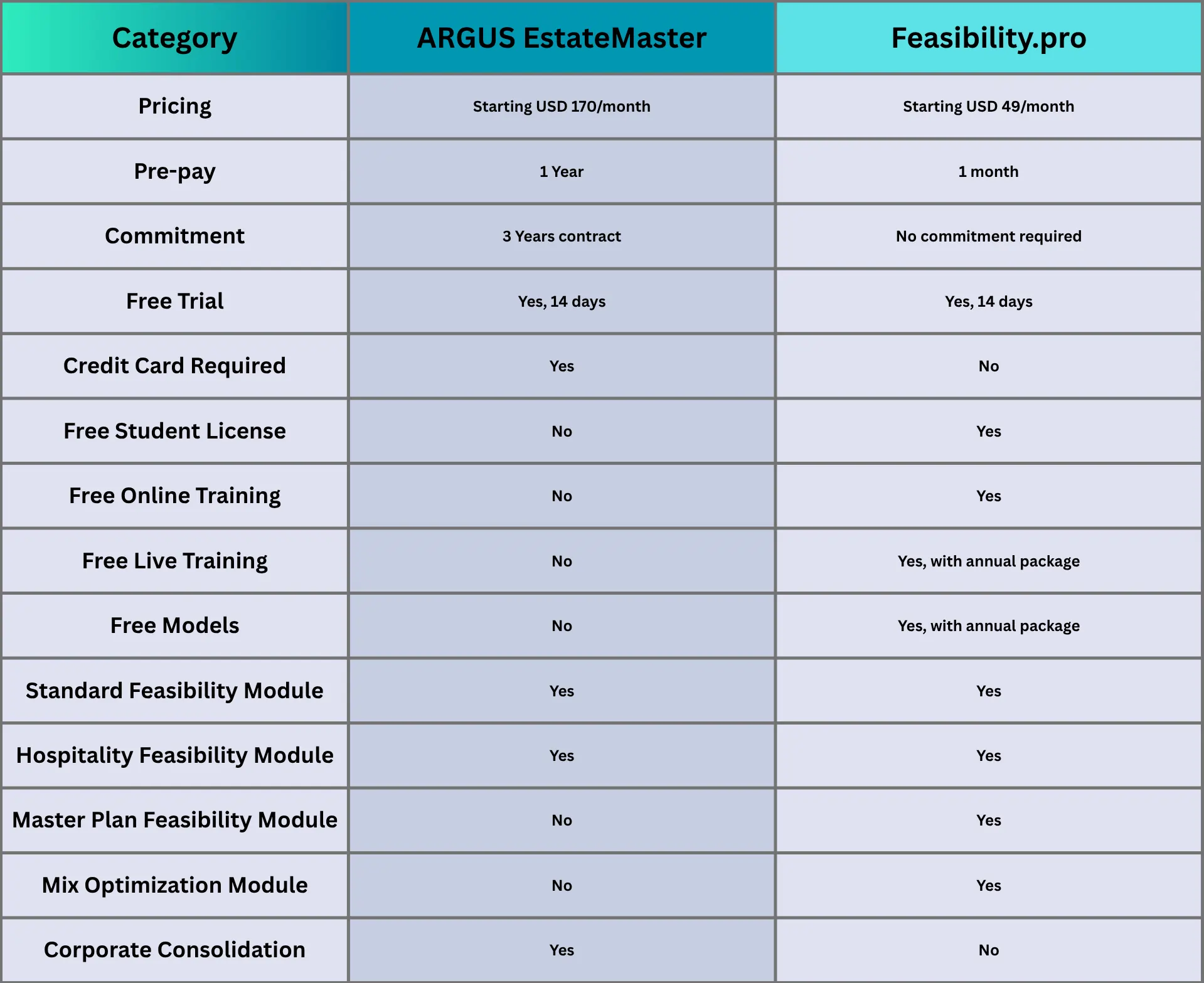
The pricing structure for ARGUS EstateMaster is notably less transparent, with public pricing details largely unavailable across various review platforms. Licensing fees are based on a sliding scale determined by the Gross Internal Floor Area (GIA) of the proposed building, offering three distinct levels of access: 'Ball-Park Appraisal,' 'High-level site-specific benchmarking,' and 'Detailed site-specific benchmarking'. A Reddit comment from five years ago mentions a potential monthly plan of $400-$500, though its current availability is uncertain. A 14-day free trial is consistently offered.
Feasibility.pro adopts a highly transparent, module-based pricing model with both monthly and annual subscription options. Annual plans offer a significant 50% discount (e.g., Standard Feasibility: $99/month or $594/year; Masterplan: $199/month or $1194/year; Value Pack including all four modules: $335/month or $4020/year). It operates on a "no commitment, transparent pricing, pay as you go" model, allowing users to cancel anytime without hassle. A 14-day risk-free trial is available without requiring credit card information. A standout feature is its commitment to education, offering 100% free access for students and faculty.
Support & Learning Resources
ARGUS EstateMaster provides a variety of training modalities, including public, private, and eLearning/online courses, alongside certification training. It offers "ample case studies for practical analysis" and comprehensive in-software help, including a "Help Menu" and "instructional dropdowns". Support channels include Email, Phone, and 24/7 Live Chat. However, some user reviews have noted issues with customer service wait times and availability, suggesting potential areas for improvement in responsiveness.
Feasibility.pro emphasizes strong user support and learning. It offers free on-demand training for monthly subscribers and four live sessions with experts for annual subscribers. A key selling point is its claim of "unmatched 24x7 support" , aiming to provide continuous assistance to its users.
Read More About: What is a feasibility study?
Key Differentiators and Considerations
ARGUS EstateMaster's Strengths
Proven Track Record & Industry Standard: With over two decades in the industry, it is a highly trusted, established, and "proven solution". Its reports are often "industry-recognized and accepted" , which is crucial for formal submissions and external financing.
Comprehensive Lifecycle Management: Offers robust capabilities in Development Management, Investment Appraisal, and Corporate Consolidation/Portfolio Management, extending its utility beyond initial feasibility to ongoing project tracking, long-term valuation, and enterprise-wide portfolio oversight.
Advanced Risk Modeling: Provides sophisticated probability analysis with high simulation capabilities (up to 2,000 simulations), offering a deeper quantitative understanding of project risk.
Existing API: Features a functional API for custom data extraction, catering to organizations with complex business intelligence and data warehousing needs.
Feasibility.pro's Strengths
Next-Generation Speed & Efficiency: Claims to be "30% faster" than competitors, actively streamlining workflows and reducing reliance on manual, error-prone Excel processes.
Specialized Modules: Offers unique and comprehensive modules for Master Plan Feasibility, Hospitality Feasibility (with USALI P&L), and Product Mix Optimization, providing highly tailored analysis for intricate and niche development types.
Accessibility & Transparent Pricing: Features modular, pay-as-you-go pricing, a 14-day risk-free trial, and, notably, 100% free access for students and faculty, significantly democratizing access to advanced feasibility tools.
User-Friendly Interface & Support: Designed with an intuitive interface for ease of use and boasts "unmatched 24x7 support," prioritizing continuous and immediate user assistance.
Modern Approach: Positioned as a cloud-first (implied by web-based deployment), agile, and continuously evolving platform with "upcoming APIs" for future enhancements.
Pricing & Services Overview EstateMaster vs Feasibility.pro
Conclusion
Feasibility.pro, emerges as a "next-generation" tool, prioritizing speed, specialized modules for complex niches, transparent pricing, and broad accessibility, including a commendable commitment to empowering future real estate leaders through free educational access. Its agile approach and focus on user experience position it as a strong choice for those seeking efficiency and tailored solutions for modern development challenges.
Both ARGUS EstateMaster and Feasibility.pro stand as powerful and capable solutions for real estate feasibility analysis, each carving out a distinct niche with its unique strengths. EstateMaster, with its long-standing reputation and comprehensive suite, excels in providing an end-to-end solution for project and portfolio management, making it a strong contender for large, established enterprises seeking a time-tested, integrated system. Its depth in traditional investment appraisal and advanced risk modeling capabilities cater to organizations with complex financial requirements and a need for industry-standard reporting.