
What Is Multifamily Real Estate?
Multifamily real estate refers to residential properties with two or more separate living units, such as apartments, condos, townhomes, and build-to-rent communities. It’s a major asset class within commercial real estate and often attracts both professional operators and passive investors.
Multifamily properties share physical systems and offer investment benefits like passive rental income, portfolio diversification, and potential tax advantages. As the largest of the core CRE sectors, it remains relatively straightforward and resilient across market cycles.
With increasing accessibility, multifamily real estate is an attractive option for those seeking to enhance a traditional 60/40 investment portfolio.
In this post we will learn the basics of multifamily real estate investments. Multifamily real estate investment has many benefits including cash flow, passive income, valuation potential and lowered risks. In the previous post I have discussed the benefits of multifamily investment.
If you are not sure about real estate as an investment, you should have a look at the returns it offers.
Also Read: Multifamily vs. Single Family Investment?

Read More About Benefits of multifamily investment
Understanding Multifamily Real Estate Investment
Multifamily investing involves acquiring properties with two or more units for rent, such as apartment buildings and condo complexes. Unlike single-family homes, this strategy often involves a more sophisticated business plan, including lease-up and value-add improvements. It's a key player in commercial real estate, alongside office, retail, and industrial investments.
Why Invest in Multifamily Properties? 📈
Investors typically aim to boost Net Operating Income (NOI) by:
- Increasing occupancy rates ⬆️
- Raising average rents 💰
Success also depends on a favorable sale price at exit, driven by market shifts or property enhancements.
Key Metrics for Evaluating Multifamily Investments 📊
Savvy investors analyze several crucial factors:
- Occupancy rate: How many units are currently rented.
- Capitalization rate (Cap Rate): A measure of the property's potential return.
- Sales & rental comparisons ("Comps"): Benchmarking against similar properties in the area.
- Market demand drivers: Including population growth and job growth.
Market Dynamics: Supply & Demand interplay 🔄
Multifamily investment performance is heavily influenced by supply and demand:
- Supply constraints can lead to higher rents and increased property values.
- Local factors like zoning and permitting impact supply.
- Macroeconomic factors also play a significant role.
- Current outlook: Demand for rentable units in the U.S. generally outpaces supply. While the supply pipeline is strong for 2024, it's expected to thin out in 2025 and beyond due to rising interest rates halting new projects.
Different Classes for Multifamily Investments?
Multifamily investments are typically categorized into three main classes—Class A, Class B, and Class C—based on property age, condition, location, and tenant profile:
🅰️ Class A
New or recently built (less than 10 years old)
Located in prime areas
High-end amenities and finishes
Attracts high-income tenants
Low maintenance, lower cap rates
🅱️ Class B
10–30 years old, well-maintained
Located in decent neighborhoods
Moderate amenities, some updates
Appeals to middle-income renters
Higher value-add potential than Class A
🅲 Class C
30+ years old, needs renovation
Located in less desirable areas
Basic or outdated amenities
Lower-income tenant base
Highest risk but best cash flow potential
Why Multifamily Real Estate Investment Is a Smart Choice?
A multifamily real estate offers amazing options and a wide range of choices in whatever way the investor wants to move. Some key factors that make multifamily real estate investment a prime and coveted investment option are:
Attractive Rental Options
Multifamily properties offer steady passive income and portfolio diversification. With demand for rentals growing, this asset class consistently delivers above-average ROI, even during downturns.
✔ Average rental yields in multifamily can range from 6% to 10%, making it a reliable income source.
The Millennial Demand
Millennials and Baby Boomers prefer flexible, low-maintenance living, fueling demand for rentals in urban areas. Multifamily units offer affordable ownership and easy resale, making them attractive to both tenants and investors.
Quick Growth and Exponential Value Appreciation
Multifamily investments grow exponentially with minimal upgrades. Shorter lease terms allow frequent rent adjustments, and the appreciation rate in multifamily often outpaces that of single-family properties.
✔ According to CBRE, multifamily assets have shown 15% YoY appreciation in some metro markets.
Attractive Financing Options
Lenders favor multifamily properties due to their lower risk profile and stable cash flow, making it easier to secure funding. Even with partial vacancy, the property still generates income, reducing lender risk.
Increase in Housing Demand for Workforce Segment
With rising urban migration and gig economy growth, workforce housing demand is booming. Multifamily units offer budget-friendly, community-based living, making them a top choice for mobile workers and short-term residents
Recession and Pandemic Resilient
Multifamily housing proved highly resilient during COVID-19, with occupancy rates in stabilized properties often staying above 90%. Housing is a necessity, making these investments less volatile than retail or office spaces.
Investment Portfolio
Instead of managing several single-family units, one multifamily property means one loan, one location, one insurance policy, and multiple income sources. It's an efficient way to scale and diversify your real estate portfolio.
Real Estate Crowd Funding
Crowdfunding makes it easier to participate in multifamily deals with as little as ₹50,000 to ₹1,00,000 (or USD equivalent), enabling fractional ownership. Great for renovations and value-add projects, though risks are higher due to shared ownership.
Property Management
With steady income, it becomes financially viable to hire a property manager, reducing operational stress. This is a huge edge over single-family units, where self-management is often a necessity.
Real Estate Investment Trusts (REIT)
With steady income, it becomes financially viable to hire a property manager, reducing operational stress. This is a huge edge over single-family units, where self-management is often a necessity.
You May Also Like To Read: 13 Amazing Ways to Increase Revenue in Multifamily Real Estate
How to Finance Your Multifamily Real Estate Investment?
There are three most popular investment and financing modes for multifamily real estate investment. These are:
- Financiers and Bank Loans – This is the most traditional form of real estate investment. Banks and Financiers prefer multifamily real estate investment for its various advantages. However, this mode puts the strain solely on the developer’s shoulders.
- Crowdfunding – This is an attractive, but high risk and high return mode of Multifamily real estate investment, primarily because of the involvement of multiple investors.
- Real Estate Investment Trusts (REITs) - REIT is the most cost effective and risk tolerant multifamily real estate investment. Adding to its benefit is the fact that it behaves like stocks and generates a passive income, and also offers quick and easy liquidity option.
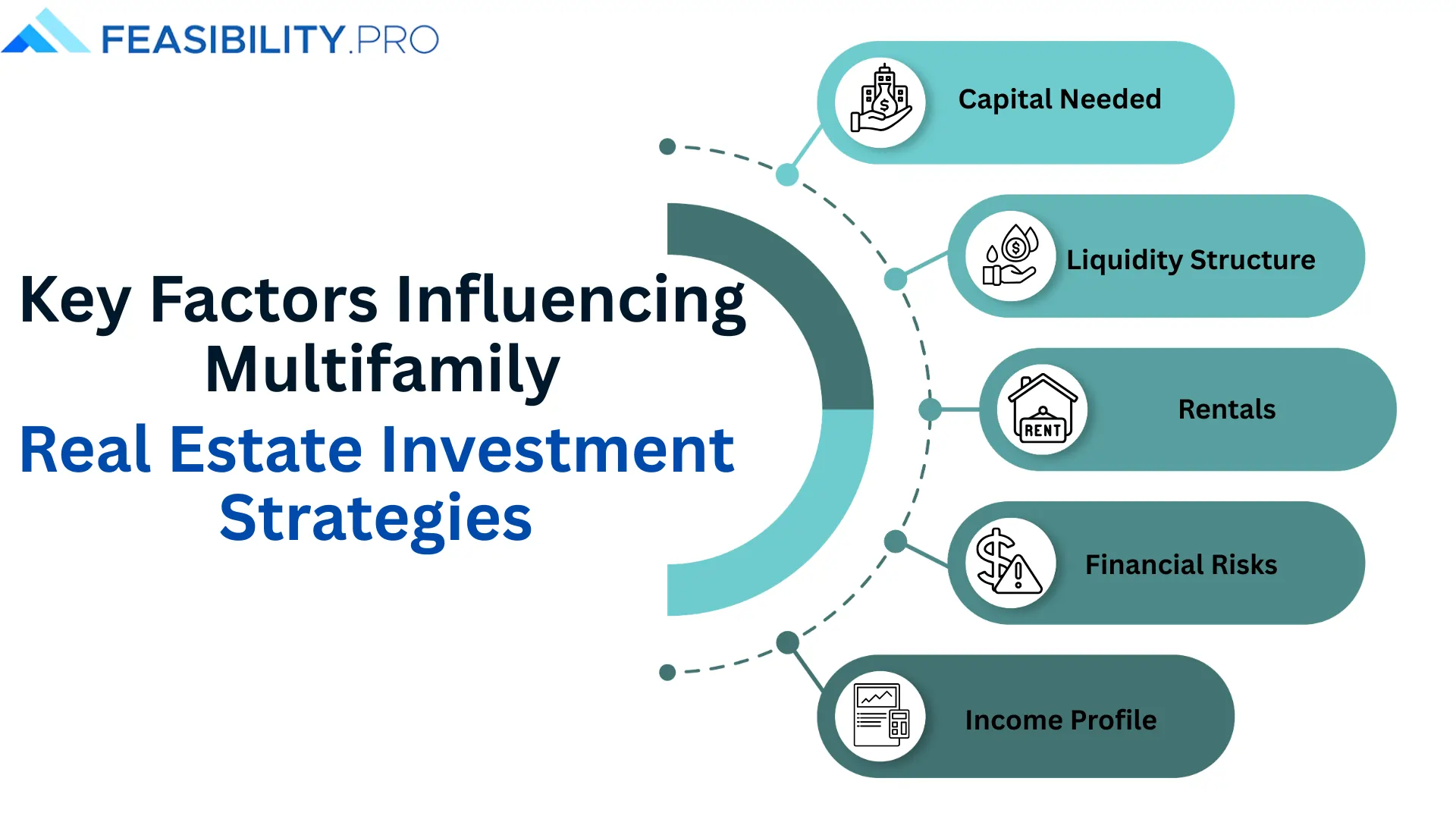
Key Factors Influencing Multifamily Real Estate Investment Strategies
After having understood the advantageous position of multifamily real estate investment in real estate investment arena, and the popular investment modes, it is particularly important to go for the correct and the best-suited investment strategy.
Every multifamily real estate profile has different requirements and structures. One investment strategy does not fit all profiles.
In deciding the best-suited investment strategy, some key requirements need to be carefully considered, with regard to finances. These are mainly –
Capital Needed
Capital required and capital available with the developer or the investor is a most important consideration. It is a good idea to put 20% of the purchase price away, and accurately calculate the closing costs and the reserve amount.
Liquidity Structure
Liquidity of finances when needed is an important consideration. Selling a multifamily real estate generates the liquidity needed. Here the valuation of the multifamily real estate property must be updated. But this process is tedious and can take months, specially so in crowdfunding. In REITs however, liquidity can be achieved immediately because REITs can be sold like stocks.
Rentals
Rentals in multifamily real estate investment are a guaranteed way of generating passive and consistent revenue. This can create a safe pocket for the investor, but needs a great deal of personal involvement.
Financial Risks
Whatever the strategy, it is extremely advisable to consider the risks in each investment strategy, and juxtapose it with the returns. This helps the investor and the developer to know how much risk can be taken, and helps to fortify against the risks. It is all about taking a calculated risk, if at all.
Income Profile
It is important to have a knowledge of the income needed to be generated. The risks taken and the investment strategy opted for, depend on the income required to generate from the multifamily real estate investment strategy.
Conclusion
With one of the highest average total returns of 9.75% and a deviation of a low 7.75%, multifamily real estate investment is one of the most lucrative investing options in the real estate market. The rich and the powerful elite segment of the society have long been minting money through multifamily real estate investment. However, with REITs, Crowdfunding, Loans, new investors are braving the real estate moguls and entering the real estate market. These new investors bring in new blood, making multifamily real estate investment the investing trend in real estate.
Hope you enjoyed this post on the basics of multifamily real estate investment, let me know what you think in the comment section below.
You should also explore below external contents:
Ways to Boost Your Real Estate Business
Rent vs Buy: What’s the Best Choice in 2025?
FAQ
What is multifamily real estate?
Multifamily real estate encompasses properties with two or more separate living units, such as apartment buildings and condos. It's a key commercial real estate asset class, generating income from multiple tenants within a single property.
What are the major pros and cons of multifamily real estate investment?
When it comes to real estate investments, multifamily properties have a lot to offer. - Cash flow: One of the best things about investing in multifamily real estate is that rental income guarantees a steady monthly cash flow. - There are a lot of good things about investing in multifamily properties, but not everyone can do it. — More expensive to start: No matter how profitable a multifamily rental property might be in the long run, there's no getting around the fact that it costs a lot up front.
Why is multifamily investing considered a smart choice?
It offers steady passive income through rents, diversifies portfolios, and has strong appreciation potential. Multifamily properties are also notably resilient during economic downturns, making them a relatively stable investment.
What are the main classes of multifamily properties?
Multifamily properties are categorized into Class A (new, luxury), Class B (well-maintained, moderate age), and Class C (older, needing renovation). Each class differs in age, condition, location, and tenant profile.
Is buying a multifamily home a good investment?
In order to expand your real estate holdings and earn more money, consider investing in multifamily properties. Depending on the amount of rental units, owning multifamily buildings may be a minor or major task.