Step by Step Real Estate Cash Flow Forecast
A real estate cash flow forecast is more than just a spreadsheet — it’s a roadmap to understanding how an investment property will perform over time. Whether you’re analyzing a single rental unit, a multi-family complex, or a mixed-use development, cash flow forecasting in real estate helps investors make smarter buying, financing, and selling decisions.
This guide walks you through how to create an accurate, investor-ready real estate cash flow projection that can guide long-term investment success.
You May Also Like to Read: Discounted Cash Flow Analysis and Discount Rate
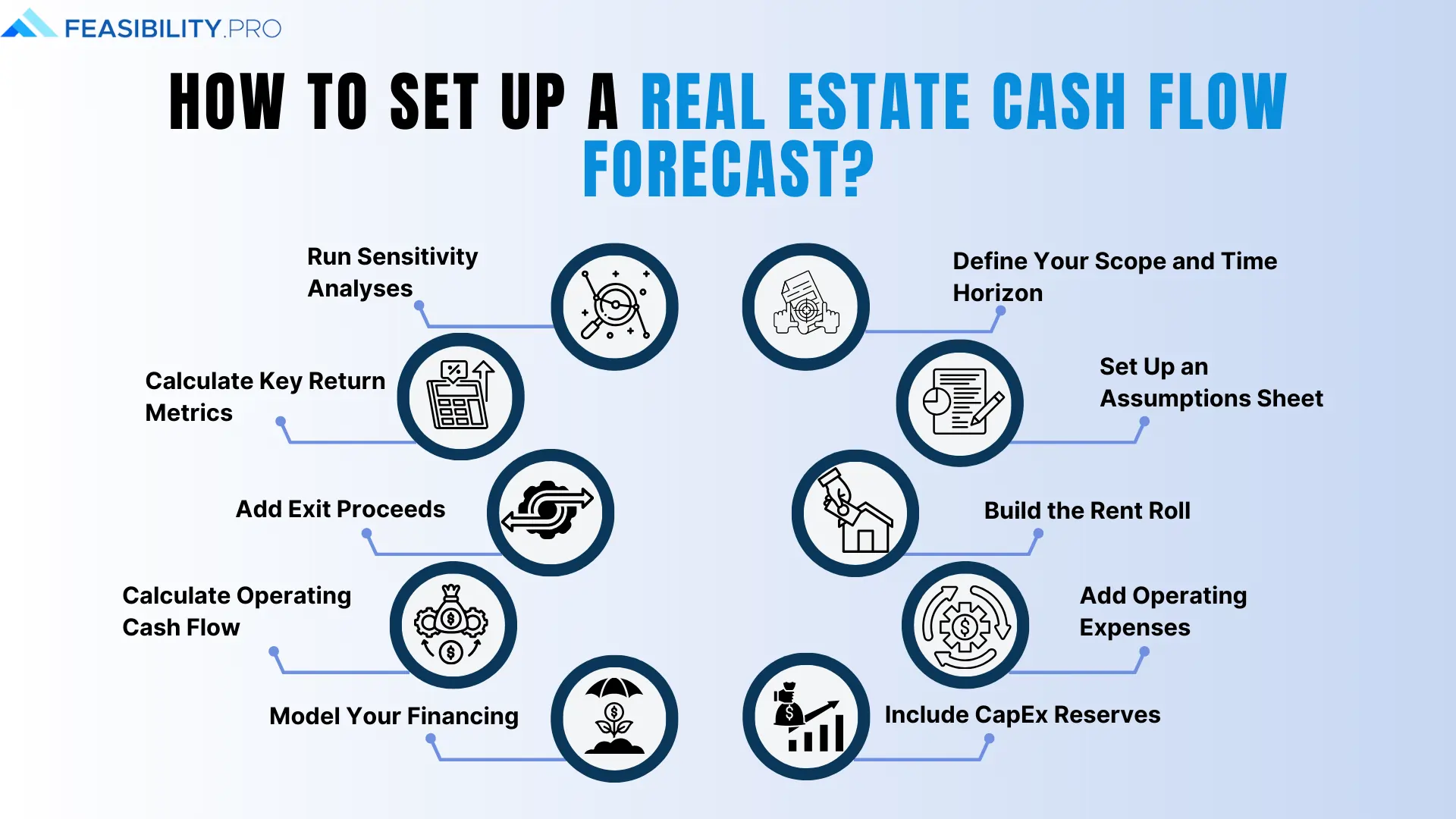
1. Define Your Scope and Time Horizon
Before calculating numbers, clarify:
- Purpose: Buy-and-hold rental, short-term rental, development project, or flip.
- Forecast Period: Monthly projections for Year 1, then annual for Years 2–10.
- Currency and Taxes: Use one currency and decide on pre-tax or after-tax forecasting.
Pro Tip: Start with pre-tax figures for easier deal comparisons. This is a foundational step in cash flow forecasting in real estate.
2. Set Up an Assumptions Sheet
The assumptions sheet is your foundation. Store all inputs here for quick updates. Include:
- Acquisition costs (purchase price, closing costs, renovation budget)
- Income details (rent, other income streams, annual growth)
- Vacancy & credit loss percentage
- Operating expenses (taxes, insurance, repairs, management fees, utilities, HOA dues)
- CapEx reserves
- Loan terms (LTV, interest rate, amortization period)
- Exit strategy (hold period, exit cap rate, selling cost percentage)
A clear assumptions sheet makes it easier to refine your real estate cash flow projection without reworking the entire model.
3. Build the Rent Roll
A rent roll shows rental income potential:
- List units (type, size, current rent, market rent)
- Calculate Gross Potential Rent (GPR) = Market rent × 12 months
- Apply vacancy loss
- Effective Gross Income (EGI) = GPR – Vacancy Loss + Other Income
Cash flow forecasting in real estate often starts with a detailed rent roll to ensure revenue estimates are accurate.
4. Add Operating Expenses
List fixed and variable expenses like property taxes, insurance, maintenance, management fees, utilities, and HOA/condo fees.
Net Operating Income (NOI) = EGI – Operating Expenses.
Your real estate cash flow forecast depends heavily on precise net operating income calculations to measure profitability.
5. Include CapEx Reserves
Set aside reserves (flat per unit or % of EGI) for major replacements like roofs and HVAC systems. This ensures your real estate cash flow projection reflects future capital needs.
6. Model Your Financing
- Loan Amount = Purchase Price × LTV
- Annual Debt Service = Monthly Payment × 12
- Debt Service Coverage Ratio (DSCR) = NOI ÷ Debt Service (ideal: 1.25× or higher)
The debt service coverage ratio helps determine if your property’s cash flow can comfortably cover loan payments.
7. Calculate Operating Cash Flow
- Cash Flow Before Debt = NOI – CapEx Reserves – Planned CapEx
- Levered Cash Flow (Pre-Tax) = Cash Flow Before Debt – Debt Service
8. Add Exit Proceeds
When selling:
- Terminal Value = Next Year’s NOI ÷ Exit Cap Rate
Subtract selling costs and remaining loan balance
9. Calculate Key Return Metrics
Your forecast should produce these investor KPIs:
- Cash-on-Cash Return = Annual Levered CF ÷ Equity Invested
- Average Cash-on-Cash over the hold period
- Equity Multiple = Total Cash Inflows ÷ Total Equity Invested
- Internal Rate of Return (IRR) = Annualized return including sale
- NPV (Net Present Value) at your target discount rate
10. Run Sensitivity Analyses
Create scenarios to test how your deal holds up under different assumptions:
- Rent growth ± 1–2%
- Vacancy 5–10%
- Interest rate changes ± 1%
- Exit cap rate shifts ± 0.50%
This helps you see best-case, base-case, and worst-case outcomes.
Example: Year 1 Rental Forecast
| Item | Amount | |
| Gross Potential Rent (GPR) | $691 | |
| Vacancy Loss (5%) | -$35 | |
| Other Income | $22 | |
| Effective Gross Income (EGI) | $678 | |
| Operating Expenses (35% EGI) | -$237 | |
| NOI | $441 | |
| CapEx Reserves (3% EGI) | -$20 | |
| Debt Service | -$219 | |
| Levered CF (Pre-Tax) | $202 | |
| Year 1 Cash-on-Cash | 20% | |
| DSCR | 2.02× | |
Common Mistakes to Avoid
- Mixing CapEx with operating expenses.
- Forgetting to budget for property tax reassessments after purchase.
- Overestimating rental income without factoring in vacancy.
- Ignoring loan payoff and selling costs in the exit year.
You May Also Like to Read: Capital Asset Pricing Model (CAPM) and its Role in Discounted Cash Flow Analysis (DCF)
Conclusion
A real estate cash flow forecast is both a decision-making tool and a performance tracker. Update regularly to spot risks early, adapt strategies, and maximize returns. Whether building a real estate cash flow projection for a rental property or a development deal, tracking net operating income and monitoring your debt service coverage ratio will help you make confident, data-driven investment decisions.