
Understanding the Time Value of Money: A Key to Real Estate Feasibility
In real estate development, profitability isn't just about comparing total costs to total revenues—it's about when those costs and revenues occur. This is where the Time Value of Money (TVM) becomes critical in feasibility study.
Traditional methods of project appraisal often fall short, especially under the following conditions:
• Inflationary pressures cause construction costs and sale prices to escalate beyond initial estimates.
• Longer development timelines, typically extending beyond two years, increase financial exposure and risk.
• Competing investment opportunities arise, making it necessary to assess the opportunity cost of tying up capital.
• Staggered cash flows, where both expenditures and revenues are spread across multiple phases, complicate financial analysis.
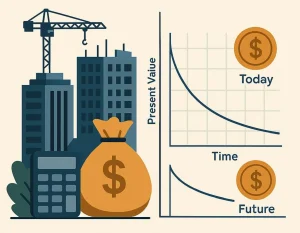
The core limitation of the traditional approach is that it fails to account for the time value of money, the principle that a dollar today is worth more than a dollar received in the future. Without discounting future cash flows, developers risk making inaccurate assumptions about profitability.
By applying TVM through tools like Net Present Value (NPV) and Internal Rate of Return (IRR), feasibility studies can provide a more accurate, time-adjusted picture of a project's financial viability. This enables smarter investment decisions, better risk management, and ultimately, more sustainable returns.
Understanding the Time Value of Money: Unlocking True Profitability in Real Estate Feasibility Studies
When evaluating the profitability of a real estate development, it’s not enough to simply compare total revenues against total costs. One of the most overlooked—but absolutely critical—concepts in financial analysis is the Time Value of Money (TVM).
TVM acknowledges a simple financial truth: a dollar today is worth more than a dollar tomorrow. This is due to factors such as inflation, investment risk, and the opportunity to earn returns over time.
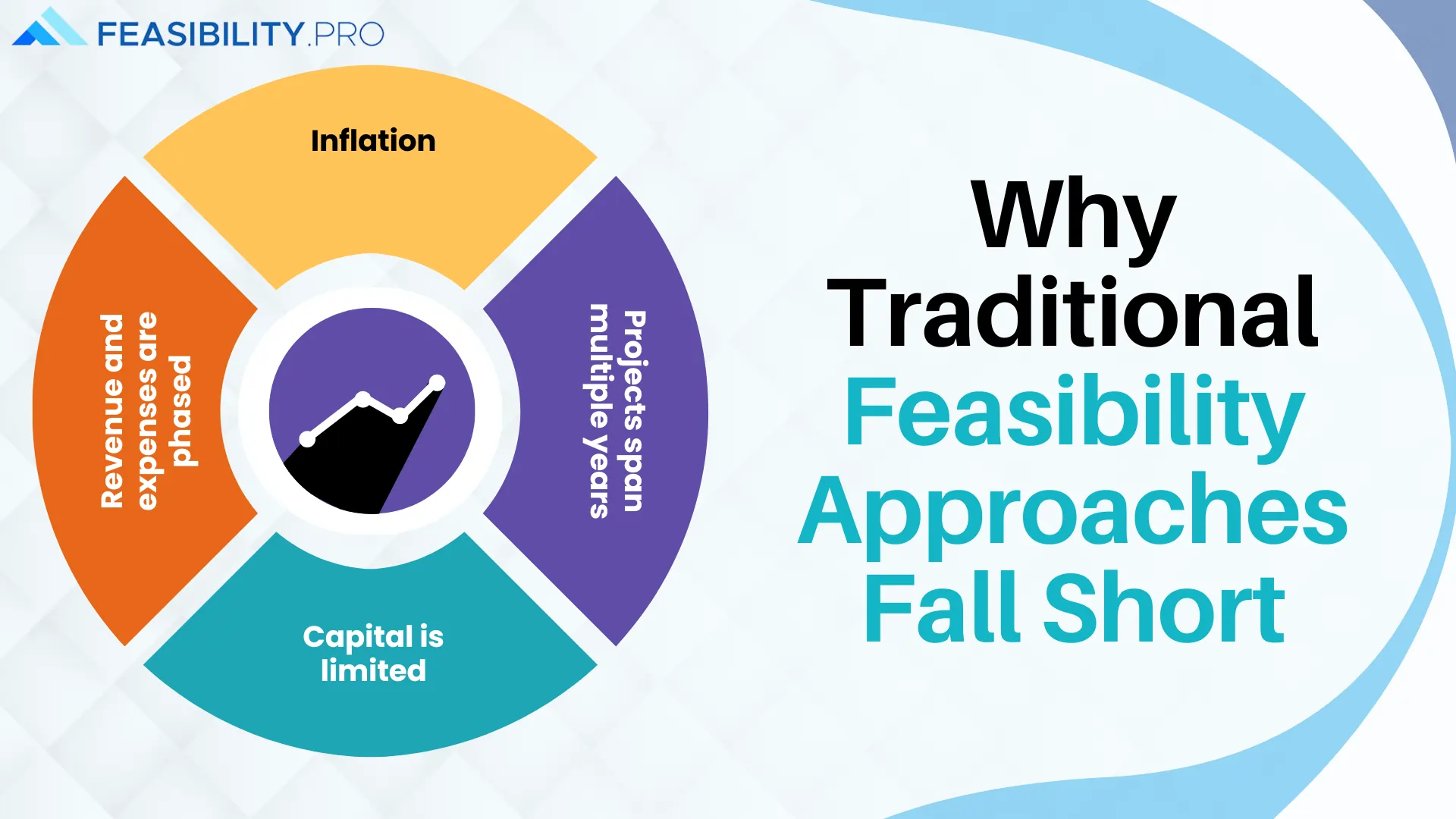
Why Traditional Feasibility Approaches Fall Short?
Conventional feasibility assessments often fail to reflect reality, especially when:
- Inflation causes future construction costs and sale prices to rise unpredictably.
- Projects span multiple years, where cash inflows and outflows are not immediate.
- Capital is limited, and developers must choose between multiple investment opportunities.
- Revenue and expenses are phased, rather than realized in a single period.
In such cases, a basic cost-revenue analysis may suggest a project is profitable when, in fact, the financial returns—adjusted for time—may be inadequate or even negative.
You May Also Like to Read: How to do a Market Feasibility Study?
Lets look at an Example: A Residential Development Project
Let’s assume a developer is assessing a residential project that requires an upfront investment of SAR 100 million and expects to generate SAR 130 million in sales revenue over 3 years. On the surface, it looks like a profit of SAR 30 million a 30% return.
But here's where TVM changes the picture.
Cash Flow Breakdown (Simplified):
| Year | Cash Flow (SAR) |
| 0 (Today) | -100,000,000 |
| 1 | 0 |
| 2 | 50,000,000 |
| 3 | 80,000,000 |
Using the Net Present Value (NPV) method with a discount rate of 10% (representing the cost of capital or required rate of return), we recalculate the present value of future cash flows:
- Year 2: SAR 50M / (1 + 0.10)^2 = SAR 41.3M
- Year 3: SAR 80M / (1 + 0.10)^3 = SAR 60.1M
Total Present Value of Revenues = SAR 101.4M
Now, compare that to the initial cost of SAR 100M. The real profit (NPV) is only SAR 1.4M, not the 30M it first appeared to be. This reflects a modest return of just 1.4% over three years when time-adjusted.
If the developer’s minimum acceptable return is 10% per year, this project fails the feasibility test despite showing a positive absolute profit.
You May Also Like to Read: FAR vs GFA vs BUA: What Every Property Developer Should Know
Why TVM Matters?
By incorporating TVM into feasibility studies using NPV, IRR, and cash flow modeling, developers can:
- Avoid misleading profitability assumptions
- Make better-informed go/no-go decisions
- Prioritize investments based on actual financial performance over time
- Effectively compare multiple projects with varying durations and capital structures
The Bottom Line
Failing to apply the Time Value of Money in feasibility studies can lead to investing in seemingly “profitable” projects that underperform or destroy value. Our feasibility tools, Standard, Hotel, and Master Plan Modules, automate time-adjusted analysis, empowering developers and consultants to make decisions grounded in real, risk-adjusted financial insight.
Let the numbers speak—not just in totals, but in time.