
Real Estate Investment – How to Get Started?
Real estate investment is a great way to expand your investment portfolio and diversify your income, but it can be tricky. Even after years of being in the business, realtors find it hard to come up with investment decisions. Therefore, it's completely normal to be overwhelmed while you are thinking to step into the industry. If you're asking yourself, "Real Estate Investment – How to get started?" this guide is for you.
Here, we will walk you through the investment process so that it becomes easy for you to decide upon the option that will serve you the best. This beginner's guide to real estate investment covers everything you need to know.
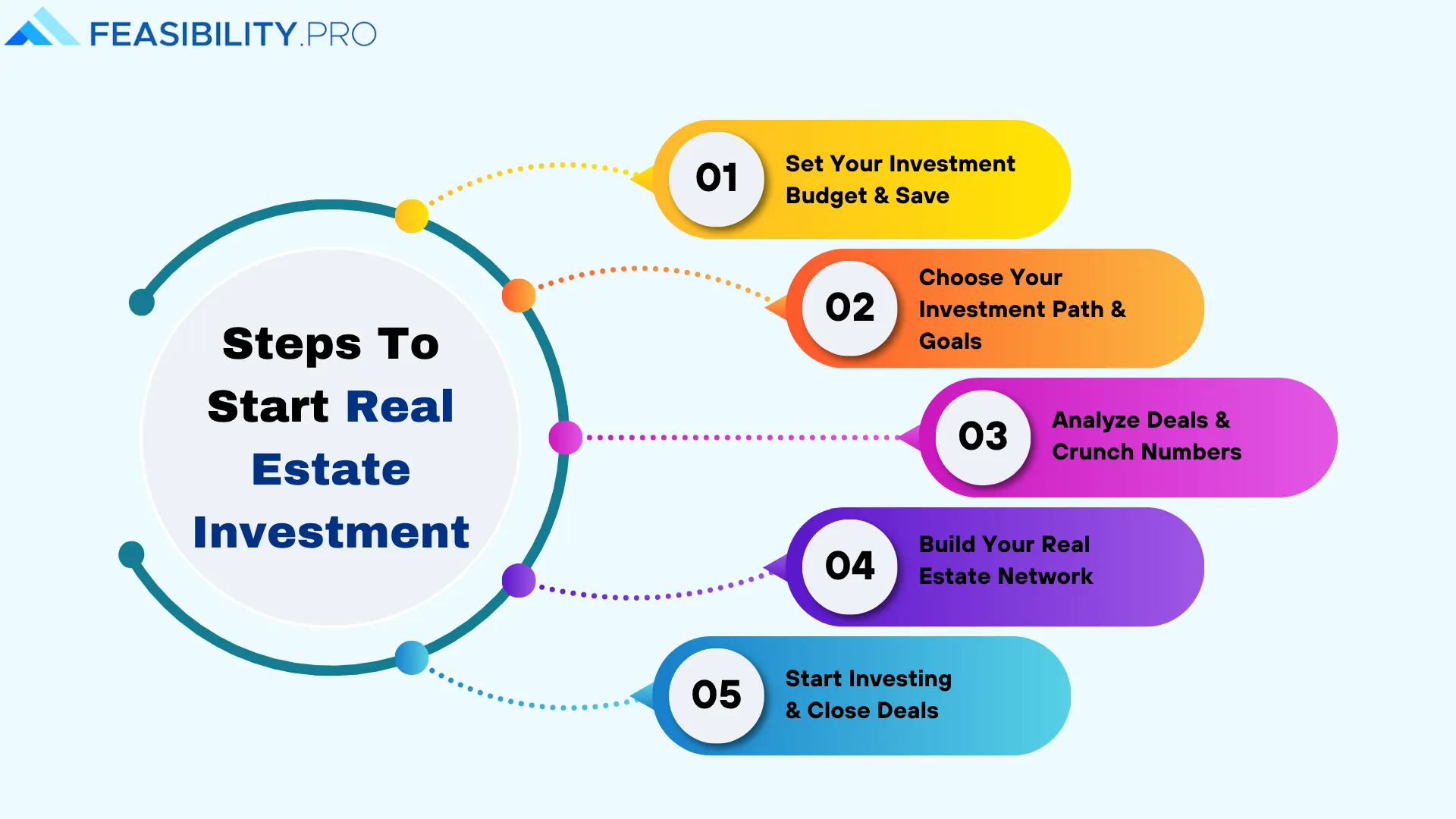
Just like any other investment, the process for a real estate investment can be broken down into the following five steps:
- Set Up a Budget and Start Saving
- Identify Your Goals and Choose Your Investment Option
- Number Crunching and Analyzing Deals
- Build Relationships
- Start Investing
Let's discuss these steps in detail one-by-one.
Meanwhile you may also like to read the benefits of multifamily investment.

1. Set Your Investment Budget & Save
As soon as the word real estate investment comes to your mind, the first thing you must do is to analyze your funds. Look into your savings, set a specific budget to maximize real estate investment, and ideally, set up a separate account for these funds. It's always wise to build a fund in advance while you analyze your investment options.
It's a common myth that real estate investing requires millions. While some investments do require surplus funds, you can start real estate investing with as low as $500 through options such as Real Estate Investment Trusts (REITs) and online crowdfunding platforms. Thus, low capital real estate investment is entirely possible and not a limiting factor.
If you're looking to invest in more conventional options like a housing property or a commercial property, you must carefully scrutinize various financial aspects such as your income and market risks. These investments can be expensive due to maintenance and mortgage costs. Besides money, these investments will also consume a lot of your time, so be prepared. This is a crucial step for real estate investing for beginners.
2. Choose Your Investment Path & Goals
Once you set up an investment account, you must start setting clear investment goals. What do you want to achieve with your real estate investment? Once your aim is defined, start examining the real estate sector and look into various investment options available. Understanding these is key to how to get into real estate investment.
Some common real estate investment strategies for beginners include:
Residential Properties: Often a favorite for real estate investment. Whether you want to buy a house for yourself or invest in rental properties to earn additional income, they offer promising returns. You can also earn profits by flipping properties.
Commercial Properties: Constitute properties like office buildings, apartment buildings, hotels, and shopping malls. They have huge income potential from both rental income and capital gains, but require a significant initial capital, which can be risky for new investors.
Industrial Properties: Refers to structures like warehouses and storage units. These have great earning potential due to increasing demand for logistics and storage space.
Real Estate Investment Trusts (REITs): Many real estate firms sell shares to raise capital. Similar to stocks, you get ownership rights and dividend income. REITs are very liquid and an excellent way to diversify income without directly managing properties.
Online Crowdfunding: Platforms let you invest in ongoing development projects by pooling money. This is an accessible way to participate in large commercial and residential projects, offering periodic distributions and dividend income. Knowing about real estate crowdfunding explained can open new doors.
Carefully analyze the pros and cons of each option and choose the one that best aligns with your goals and budget.
3. Analyze Deals & Crunch Numbers
Once you've decided where you want to invest, the next major step is to start looking for deals. When analyzing deals, you'll need to do some serious number crunching. For instance, you'll need to come up with an estimated income potential a given real estate investment offers. This is vital for how to analyze real estate deals.
You'll also need to calculate your mortgage costs, maintenance charges, property taxes, insurance, and other expenditures attached to your purchased property. When estimating income potential, ensure you do thorough market research. Analyze property demands in that area, including demand patterns and fluctuations. Understanding real estate investment financial analysis helps you make informed choices.
Read More About: Real Estate Feasibility Analysis – Key Success Factor
4. Build Your Real Estate Network
Connections are a basic requirement of any business, and real estate is no different. While you may not necessarily need to hire employees, you'll need advice from financial experts and realtors. You'll also need help from independent contractors to manage your investment. This is a key part of how to start real estate investing successfully.
If you plan to invest in a large project, you'll also need property management firms and maintenance services. This highlights the need to build a strong network with service providers who have expertise in their respective fields. These connections will help you at every stage of your business. Understanding real estate investor network tips is crucial.
Here are some important contacts for real estate investors you must get acquainted with:
- Financial Experts
- Realtors (especially those specializing in investment properties)
- Property Management Firms
- Maintenance Firms
- Accountants
- Money Lenders/Mortgage Brokers
- Real Estate Attorneys
- Closing Agents/Title Companies
- Home Inspectors
Various contractors like Electricians, Plumbers, Painters, Handymen, Pest Control Services, Gardeners, etc. Build personal connections. You can find the best players online. Start contacting them, fix appointments, and engage in both business and personal conversations. Once you approach a few, you'll get referrals for others, helping you create a well-coordinated network.
5. Start Investing & Close Deals
The final stop on your investment journey is to start looking for deals and making offers. Finding a deal is like solving a puzzle; you'll need to try different combinations before all the pieces fit together. The real estate market is not always hot, so exercising financial discipline and making offers promptly is crucial.
It's tricky to come up with offers initially, but your connections will help. Talk to experts and do your own research in your target area. Based on this, formulate a well-defined offer. Before presenting it, share it with your financial experts, realtors, and accountants for their advice. If they give you a green light, make the offer. After making a few offers, you'll get a better idea of what a good offer looks like. Avoid real estate investment common mistakes by getting expert advice.
Once your offer gets accepted and it looks like a good deal, do not waste much time in closing. Sometimes, taking too long can cost you a good opportunity. Your research and instinct will be your biggest assets in this final step.
Conclusion
Real Estate Investment – How to get started? It's a tricky but rewarding business, requiring careful consideration. Making a profitable investment decision is a time-consuming process. However, if you adopt a well-planned approach, it will become easier, and you'll master this art in no time.
The first step is to set up an investment account and budget. Then, identify your purpose and set well-defined goals. Next, explore various investment options, analyzing their advantages and disadvantages to find your match.
After deciding where to invest, analyze deals by crunching numbers to identify the most profitable options. Simultaneously, focus on building strong industry connections. Finally, start making offers and closing deals to begin your real Estate investment journey.