

Multifamily Investment and Multifamily Real Estate – What is it?
As the term suggests, multifamily investment is putting the investment in multifamily real estate units. In order to understand the value and profile of the multifamily Investing, it is first important to understand multifamily real estate
Multifamily real estate are housing units of different types of dwelling profiles and multiple dwelling units existing in a single building complex, or within any residential complex. It is a category of housing structure that is comprised of buildings with multiple dwelling units. It is commonly referred to as multi-dwelling units.
In a multifamily real estate dwelling complex, each of the dwelling unit is a rentable dwelling unit. The profile of this rentable, livable multifamily dwelling unit can be varied. It may be a cluster of duplexes, triplexes, penthouses, villas, apartment complexes, condominiums town-homes, and such other building units, designed for different family profiles to be housed in.
Multifamily Real Estate offers such varied and versatile options that it makes Multifamily Investing a great investment opportunity for investors looking for profitable, low risk investments. It also gives the investor the option to live in one of their own Multifamily dwelling units. These are referred to as owner-occupied property. Whether one chooses to live in the dwelling unit or rent it out, a Multifamily Investment opportunity in real estate investment is a worthy investment and a great wealth building asset.
Know More About Basics of Multifamily Real Estate Investment
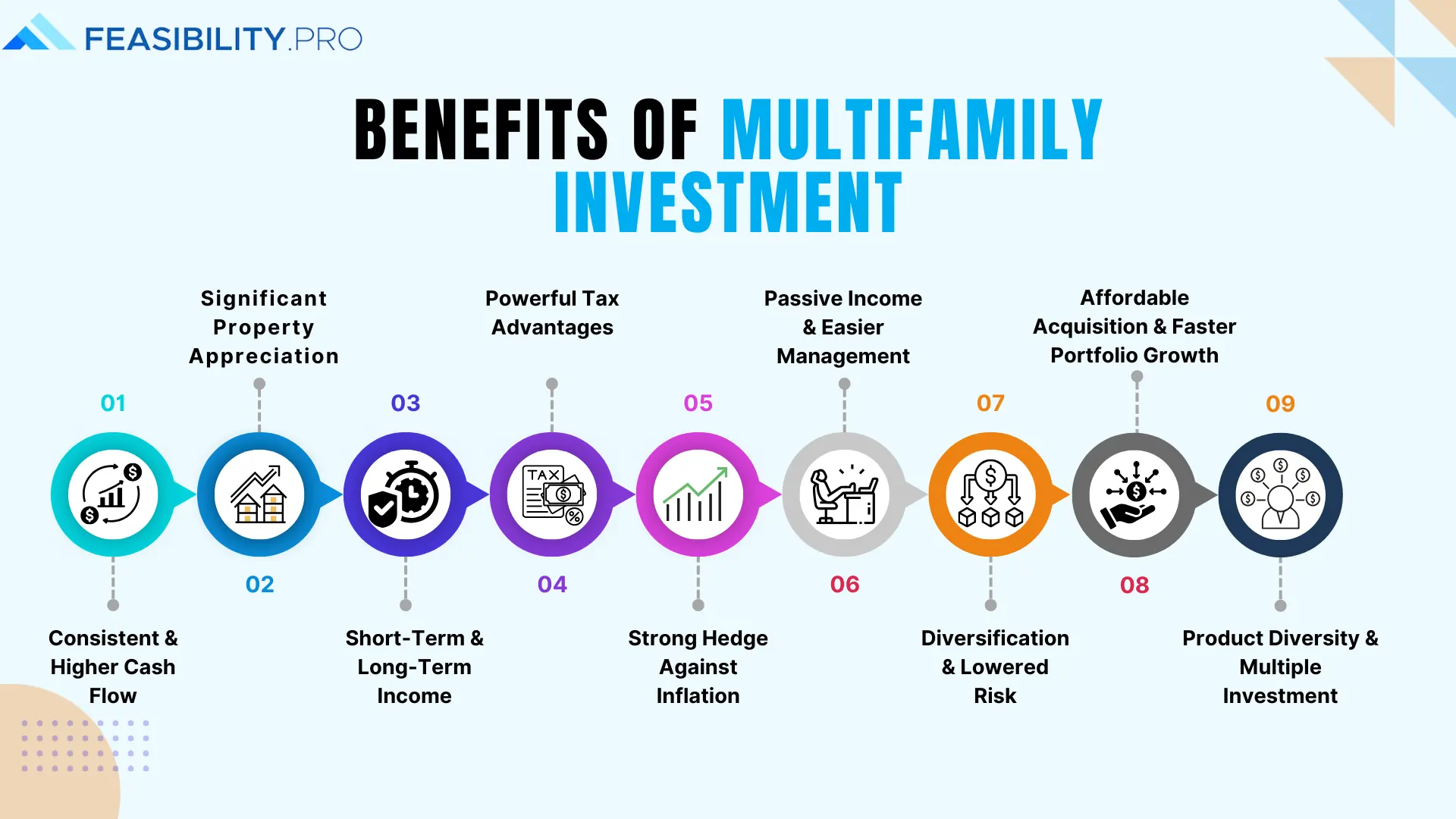
Benefits of Multifamily Investment
Real estate has long been a cornerstone of wealth creation, and within this dynamic sector, private multifamily properties are shining brighter than ever. For both seasoned and new investors, these multi-unit dwellings offer a compelling blend of stability, strong returns, and unique advantages. Here's why astute investors are increasingly choosing multifamily real estate to build their portfolios.
1. Consistent & Higher Cash Flow 💰
- Multiple Income Streams: Unlike a single-family home, multifamily properties offer diversified rental income from numerous tenants.
- Reduced Vacancy Impact: If one tenant leaves, you still have revenue from others, minimizing financial disruption.
- Economies of Scale: Shared maintenance and operational costs across multiple units lead to greater efficiency and higher net income.
- Reliable Demand: People always need a place to live, making rental income from multifamily properties relatively stable, even during economic shifts.
2. Significant Property Appreciation ⬆️
- Long-Term Value Growth: Historically, multifamily real estate has shown consistent long-term appreciation.
- Demand-Driven Growth: Population growth and urbanization continually increase the demand for rental housing.
- Value-Add Potential: Strategic renovations and property improvements can significantly enhance a property's market value, driving up appreciation.
3. Build Both Short-Term & Long-Term Income ⏳
- Immediate Cash Flow: Rental payments provide consistent short-term income.
- Long-Term Capital Gains: Property appreciation offers the potential for substantial returns when the property is sold.
- Dual Benefit: Enjoy ongoing revenue while building significant long-term wealth.
4. Powerful Tax Advantages 🧾
- Deductible Expenses: Deduct property maintenance, repairs, and management fees.
- Depreciation Benefits: Take advantage of non-cash depreciation deductions that can offset rental income and reduce taxable income.
- 1031 Exchange Opportunities: Defer capital gains taxes by reinvesting sale proceeds into another qualifying property, fostering continuous portfolio growth.
5. A Strong Hedge Against Inflation 🛡️
- Rising Rents with Inflation: Rental income from multifamily properties tends to increase with inflation, maintaining your purchasing power.
- Asset Value Preservation: Real estate historically holds and often increases its value during inflationary periods, providing a buffer against currency erosion.
6. Passive Income & Easier Management 🧘♀️
- Professional Property Management: Many multifamily deals are managed by experienced professionals, handling day-to-day operations.
- Hands-Off Approach: Investors can enjoy the benefits of passive income without the burden of active property management.
- Operational Efficiency: Managing multiple units under one roof is far more efficient than managing scattered single-family homes, justifying professional management.
7. Diversification & Lowered Risk 📊
- Spread Risk: Diversify your investment portfolio by including real estate, reducing exposure to stock market volatility.
- Reduced Vacancy Risk: With multiple tenants, the financial impact of a single vacant unit is significantly lessened.
- Recession Resilience: Multifamily properties have consistently demonstrated resilience, even in economic downturns, as housing remains a necessity.
8. Affordable Acquisition & Faster Portfolio Growth 🚀
- Cost-Efficient Per Unit: On a per-unit basis, multifamily properties can be more affordable to acquire than multiple single-family homes.
- Favorable Financing: Lenders often view multifamily properties as less risky, potentially offering more competitive mortgage rates.
- Streamlined Expansion: Acquiring one multi-unit building is more efficient and less time-consuming than buying several individual properties, allowing for faster portfolio expansion.
9. Product Diversity & Multiple Investment Opportunities 🎯
- Varied Property Types: Invest in anything from small duplexes to large apartment complexes, catering to diverse tenant profiles.
- Flexible Investment Structures: Participate individually, with partners, through syndications, or via highly liquid Real Estate Investment Trusts (REITs).
- Purpose Diversity: Invest for long-term rentals, or explore short-term lease arrangements like serviced accommodation or Airbnb.
Dive Deep Into 13 Amazing Ways to Increase Revenue in Multifamily Real Estate
Challenges of Multifamily Investing
Multifamily real estate offers undeniable allure, promising stable cash flow and significant appreciation. However, like any lucrative venture, it's not without its hurdles. For both seasoned investors and eager newcomers, understanding and preparing for these challenges is crucial for long-term success.
Here's a breakdown of the key obstacles you might face in the multifamily investment landscape:
1. Operational Complexity 🤯
- Intensive Management: Dealing with multiple leases, diverse tenant profiles, and a constant stream of repair and maintenance demands requires a highly efficient and complex management structure.
- Tenant Turnover: Managing vacancies, screening new tenants, and handling move-ins and move-outs for numerous units can be time-consuming and costly.
- Diverse Needs: Each tenant may have unique requests and payment methods, demanding a flexible and robust administrative system.
- Legal & Regulatory Compliance: Navigating local ordinances, landlord-tenant laws, rent control regulations, and fair housing rules can be intricate and vary significantly by location. Non-compliance can lead to hefty fines and legal disputes.
2. High Initial Costs 💸
- Substantial Upfront Investment: Multifamily properties, especially in prime locations, can be very expensive. This requires significant upfront capital for down payments, closing costs, and initial renovations.
- Financing Hurdles: Securing financing for large multifamily dwellings can be a daunting task, often involving stricter lender requirements compared to single-family homes.
- Escalating Construction Costs: For new developments or major renovations, rising material costs, labor shortages, and supply chain disruptions can significantly increase project budgets.
- Rising Operational Expenses: Beyond the acquisition, investors face ongoing costs like property taxes, insurance premiums, utility expenses, and administrative fees, which can also rise due to inflation.
3. Cutthroat Market Competition 🥊
- Fierce Bidding Wars: The highly lucrative nature of multifamily properties attracts a wide range of investors, from small players to large institutional "sharks," leading to intense competition.
- Disadvantage for Newcomers: Experienced and well-capitalized investors often have the ability to pay cash upfront or waive contingencies, making their offers more attractive to sellers. This can make market entry challenging for new investors who might struggle with financing.
- Limited Supply in Desirable Markets: High-demand areas often have limited inventory, further intensifying competition for prime assets.
- Due Diligence Demands: In a competitive market, quick and thorough due diligence is essential to identify viable opportunities and avoid overpaying or overlooking critical issues.
4. Inherent Risks & Market Volatility 📉
- Potential for Capital Loss: Like all commercial real estate investments, multifamily properties carry the inherent risk of capital loss if not properly managed or if market conditions turn unfavorable.
- Economic Downturns: While resilient, multifamily properties are not immune to economic shifts. Recessions can lead to increased vacancies, slower rent growth, and potential depreciation in property values.
- Interest Rate Fluctuations: Rising interest rates can increase borrowing costs for new acquisitions or refinancing, impacting cash flow and overall profitability.
- Tenant-Related Risks: While diversified, challenges like late rent payments, tenant disputes, property damage, or even tenant bankruptcies can still impact income and necessitate legal action.
- Liquidity Constraints: Real estate is generally illiquid. Selling a multifamily property can take months, which can be a challenge if immediate access to capital is needed.
You May Also Like to Read: How to get into Rental Property Business?

Also read Why am I Passionate About Real Estate?
Key Factors of Multifamily Investing
There are some key factors of multifamily investing to be kept in mind about Multifamily Investing. These key factors can make the difference between a good investment and a bad investment.
Financial Figures and Cash Flow
Numbers or financial accuracy is of utmost importance in any investment. In Multifamily Investment, investors must focus on the accurate calculations of numbers and financial figures. The financial figures help ascertain the true value of the property and expose its bottom line. An accurate difference between income and expenses is critical information when considering an Investing option. This gives a correct and a reliable picture of the Investing and helps the investor to structure their free cash flow.
Location
Another critical factor in is the location of the Multifamily Real Estate Dwelling. Location of the property defines how attractive and appealing the property is to prospective and potential tenants, buyers, renters. Properties in high-growth and high-yield areas and in well maintained neighbourhoods, are always in great demand. They attract renters very easily and hence Multifamily Investing in such lucrative location profiles rakes in the profits for the investors easily.
Number of Dwelling Units In The Multifamily Real Estate Property
The number of dwelling units a Multifamily Real Estate property offers is critical to the attraction value of the property for all prospective buyers and renters. This also includes the structure and the number of rooms per accommodation. New investors need to focus their attention on mainly three types of Multifamily dwellings. These are primarily Duplex, Triplex, and Four-plex units. These three types of dwellings are the most profitable with the lowest amount of risk. Hence these property structures are safe and viable Investing options. Also, they are more affordable and thus a good option for new investors to begin with.
Commercial Prospects and Potential Income Generation
Revenue generation is the most important and critical part of any investment. An investment that does not bring in the harvest, is of no value. Hence, ascertaining the income or revenue a Multifamily property can potentially generate, defines whether that Multifamily Investing option is worthwhile or not. Rentals and Income profiles must be accurately verified.
50 Percent Rule
Running the number check for financial accuracy is critical for Multifamily Investment consideration. However, sometimes investors do not have access to all the requisite data. In such a situation, the 50% rule is of great help as it provides a safety cushion to the investor. In the 50% rule, half of the expected income is defined as the safe income.
The Net Operating Income, NOI is the difference between the Estimated Monthly Income and the Estimated Monthly Expense. In the 50% rule, the estimated income is cut down to half. Thus, the financial safety net automatically becomes greater. 50% Rule says that only 50% of the income is to be reinvested on the expenses and all figures be calculated on 50% income only. Hence, in certain special circumstances, when all data is not available, and for new investors in the beginning of their career, the 50% Rule keeps the investor out of risk.
Costs and Credibility for Financing Options
There are various financing options for Multifamily Investing. There is owner –occupied financing options, in which the rented unit’s income is considered for the lender’s qualifying ratio. The credit score of the Investors is also of critical importance. Investor’s credit score is a major consideration when contemplating financing options for Investing. Financers primarily consider 3 components:
Credit score of the investor
Debt-to-Income ratio
Down payment capacity of the Investor
Seller Profile
Seller profile is another key consideration in the Multifamily Investing. The price of the Multifamily dwelling, or any property varies hugely as per the profile and credibility of the seller. Hence, the investor must do proper research into the profile of the seller before embarking upon the Multifamily Investing option. “Bank-owned” properties and “for-sale-by-owner” properties are differently dealt with.
Read About Product Mix Optimization for Rental Properties
INVESTING STRATEGIES FOR MULTIFAMILY INVESTING
Investment is a big decision. Hence, it is important to choose the right kind of investment strategy. Investors should always practice due diligence and consider all aspects before embarking upon Multifamily Investment.
There are 3 primary investment strategies for Investing that are proven to give the best results. These are:
1. BRRRR Value-Add Strategy
BRRRR strategy involves-
- B - Buy - identifying and buying a value-add property
- R - Rehab- rehabilitating and renovating the property to make it ready.
- R- Rent - renting out the property.
- R - Refinance - refinancing the property to further grow the profits.
- R - Repeat - continuing the process.
This is the most popular strategy amongst investors because of its adaptability to all types of project requirements.
2. Opportunistic Strategy
Opportunistic real estate investing is cashing in on an opportunity. It involves high risk. Hence it also offers high returns potential, but only if it is done right.
Opportunistic investment strategy involves-
- Heavy Value Addition- This involving considerable renovations, because higher the investment in the property, greater the return prospects. Most of the properties in this segment are old, in need of significant make-over.
- Land Assemblage- Land assemblage is assembling or bringing together multiple plots of land into one for a big project. It requires a tedious task of dealing with multiple land and owner profiles.
- Land Banking – This is using land investment as a form of banking investment in which capital is secured by investing in land instead of securing it in a bank account. Hence, investors purchase tracts of land and secure the capital in it. This is called Land Banking. The capital appreciates with the value of the land. The Investor, or land banker sells the property at higher value.
- Land Development – This is developing a new property or re-building and redesigning an old property for investment purpose.
3. Core Investment Strategy
Core investing involves investing in stable, low-risk assets.
Core investments include property:
- Property in primary or major market areas.
- Property which is fully leased.
- Property with a good tenant base.
- Property which is upper-crust or class A or “trophy property”.
Core investment strategy is popular in hedge funds, life insurance companies, and other investment groups that rely on cash flow and cash reserve as opposed to risk on growth.
CONCLUSION
Man is a social animal. Community living provides security and comfort and affordability to people. With a disintegration of joint family structure, and emergence of the micro family units, Multifamily Real Estate dwellings offer security and comfort of a cohesive society. Also, Multifamily property is affordable and offers a wide range of choices. And with migration of people across locations and cities, buying property is not always a profitable option for the millennials, who are the biggest buying force of today. Hence rentals are the best option for them. All this makes it one of the most lucrative investments.
You should also explore below external contents on the benefits of multifamily investment in real estate:
Ways to Boost Your Real Estate Business
Rent vs Buy: Should you buy a house or rent it?
Hope you enjoyed this post on the benefits of multifamily investment in real estate, let me know what you think in the comment section below.
KEY FACTORS OF MULTIFAMILY INVESTING CHALLENGES OF MULTIFAMILY INVESTING INVESTMENT BENEFITS OF MULTIFAMILY INVESTING ADVANTAGES OF MULTIFAMILY INVESTMENT










I read your blog its so good.
Family is not an important thing. It’s everything.” – Michael J. Explore famous and best Family Quotes from Letusmakeyourich.