
What is a Feasibility Study?
Feasibility Study is the very starting point of any new project. It would not be incorrect to say that the successful implementation of a project inevitably depends on the feasibility study of the project. So, it becomes increasingly important to understand the basics of the feasibility study.
Feasibility in simple words means "being possible". It is the study of the possibility of something rolling into action and achieving its target.
It is an assessment of the practicality of a proposed plan. It is a study of all possible scenarios, - economic, legal, technical, and other scheduling considerations- to ascertain the probability of successful implementation and outcome of a project plan. It tells us whether a project is worth the investment or not.
If you are new to this, you would also like to read how to do a market feasibility study?

How Does a Feasibility Study Help?
Having a brilliant idea is just the first step; transforming it into a successful reality is where the true challenge lies. Many promising concepts fail not because of a lack of vision, but due to unforeseen obstacles or insufficient preparation during the implementation phase. This is precisely where a feasibility study becomes an indispensable tool.
A feasibility study acts as a critical pre-project assessment, designed to determine the viability and practicality of a proposed project or venture. Before significant resources are committed, it systematically investigates whether an idea is technically possible, financially justifiable, legally compliant, and operationally achievable within a given environment.
Key ways a Feasibility Study helps ensure project success:
Identifies Potential Roadblocks
It meticulously examines all external and internal factors that could influence your project. These can range from market conditions, technological limitations, resource availability, regulatory hurdles, environmental impacts, to competitive landscapes. By identifying these challenges proactively, you can devise strategies to mitigate risks or adjust your plans.
Informs Strategic Decision-Making
Rather than proceeding with assumptions, a feasibility study provides data-driven insights. It empowers stakeholders to make informed decisions about whether to proceed, pivot, or abandon a project, saving valuable time and capital.
Optimizes Resource Allocation
By understanding the precise requirements and potential challenges, you can better estimate necessary resources – financial, human, and material. This prevents overspending or under-resourcing, leading to more efficient use of capital and improved budget control.
Enhances Project Viability and Profitability
A thorough study assesses the market demand, potential revenue streams, and cost projections. This helps refine the project plan to not only increase its chances of success but also to ensure greater long-term profitability and return on investment (ROI).
Strengthens Project Planning and Design
The insights gained from the study allow for the reassessment and refinement of the initial project plan. This leads to a more robust and realistic design, which significantly improves the likelihood of successful execution.
Boosts Stakeholder Confidence & Brand Image
Presenting a project backed by a comprehensive feasibility study demonstrates professionalism and a commitment to due diligence. This builds trust with investors, partners, and internal teams, ultimately contributing to a stronger brand reputation and a more positive project outlook.
You may also like to read Feasibility Study- Technical Notes & Discussion to explore this topic in detail.
What Does a Feasibility Study Ascertain?
A feasibility study uncovers the strengths and weaknesses of a proposed project or an existing business.; it's a deep dive into all critical aspects that can influence your project's journey from concept to completion. It meticulously uncovers the intrinsic strengths and weaknesses of your proposed venture, alongside the opportunities and threats present within its external environment.
Fundamentally, a feasibility study aims to provide clarity on crucial questions, helping you answer whether your project is truly viable and strategically sound. It comprehensively assesses:
- Opportunities present in the natural and external environment that can be used to advantage.
- Threats present in the natural and external environment that may hinder, delay, drain or obstruct the project’s implementation and success.
- Resources required for the project.
- Holistic analysis of prospects for success.
It provides clarity on the following questions:
- Does the company possess the required resources and technology to move through the project without internal hiccups?
- Will the project generate a sufficiently high return on its investment, and increase the profit margin?
A feasibility study identifies the below:
- Internal Project Constraints: Technical, Technology, Budget, Resource, etc.
- Internal Corporate Constraints: Financial, Marketing, Export, etc.
- External Constraints: Logistics, Environment, Laws, and Regulations etc.
Read More About: What is a property feasibility study?
Key Areas of a Feasibility Study
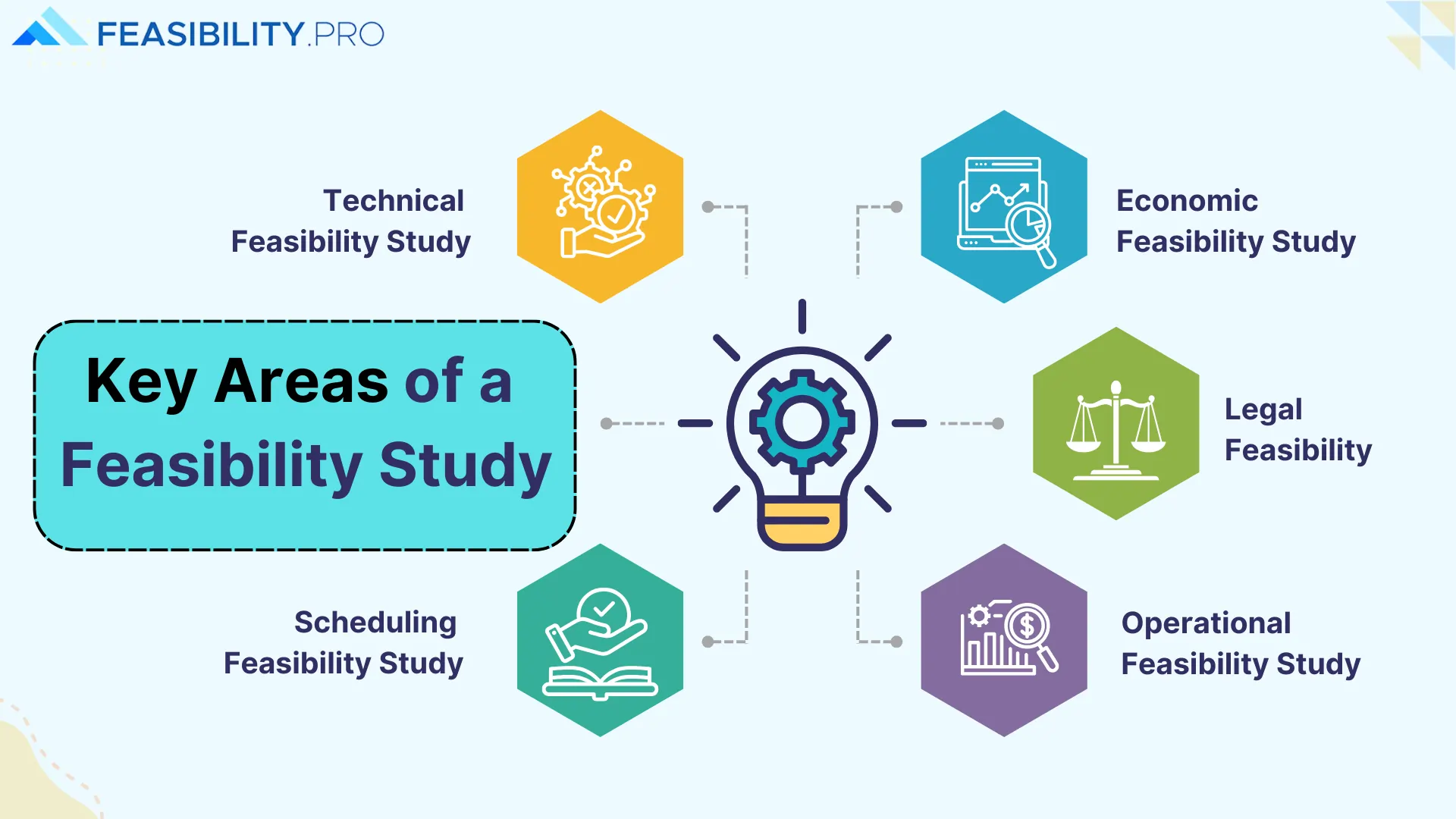
Feasibility study encompasses all possible areas and factors of external and internal influences that impact the success of a project. These areas can be primarily categorised as below (Key Areas of a Feasibility Study):
Technical Feasibility Study
This is an assessment of technical resources available to the organization. It evaluates the hardware, software, and other technical requirements of the proposed system to conclude whether the company possesses the technical and infrastructural resource to support the idea in a functional working system or not.
Economic Feasibility Study
This is an assessment of cost/ benefits analysis of the project. It evaluates the viability, cost, and benefits associated with a project, before any financial resources are allocated. It is also an independent project assessment that enhances the project’s credibility. Determining the positive economic benefits of a project to the organization, enables the company to take more profitable decisions and actions.
Legal Feasibility
This is an assessment that investigates any legal or administrative conflicts, and legal requirements like zoning laws, data protection acts or social media laws etc, that a project may run into and cause unnecessary obstructions, delays or losses. A society is governed by a set of laws. A successful project must necessarily align with the existing laws in order to move smoothly.
Operational Feasibility Study
This is an assessment of the organization’s requirements and operational resources that can be met by completing the project. Operational feasibility study examines how a project plan satisfies the requirements identified in the requirements analysis phase of system development.
Scheduling Feasibility Study
This is an assessment of the most important factor for the project’s success, which is the timeline of a project’s completion. A scheduling feasibility study estimates the time the project will take to complete.
Key Components of a Feasibility Study Report
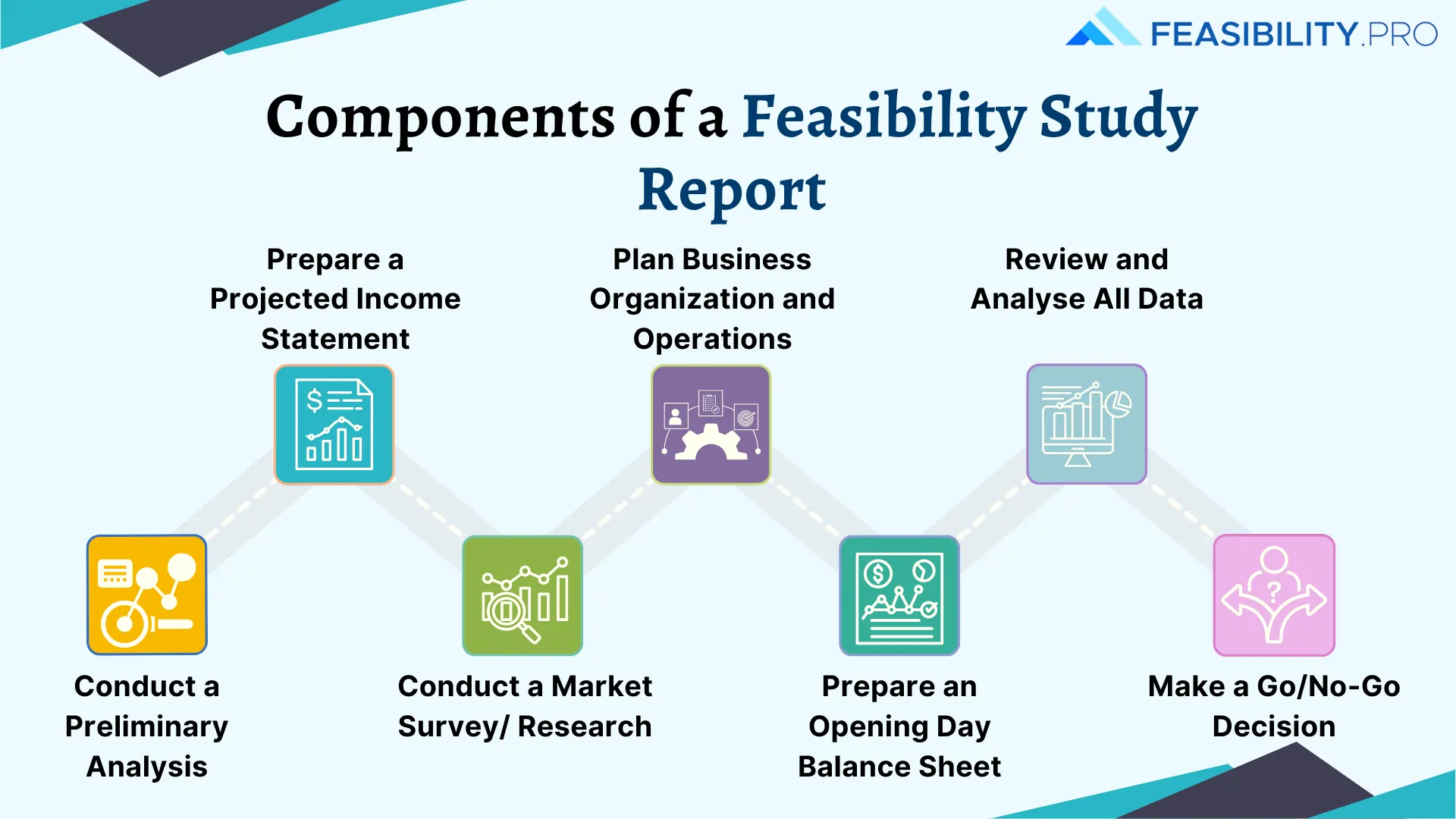
In order to prepare a good feasibility study report, it is very important to remember the below (Key Components of a Feasibility Study) :
1. Conduct a Preliminary Analysis
It is necessary to have a plan outline focusing on an unserved need, a market where the demand is greater than the supply, and whether the product or service has a distinct advantage. And one must determine if the hurdles are too high to overcome.
2. Prepare a Projected Income Statement
It is important to prepare an income statement that determines the expected income from the project, and the investment needed to achieve that goal. The income statement must include the services required, and the cost of the services, any adjustments to revenues, such as reimbursements, etc.
3. Conduct a Market Survey/ Research
This is a key to the success of a feasibility study. It provides clarity on the revenues realistically expected from the project. Some important considerations in a good market survey are -
- Geographic influence on the market
- Demographics
- Analysis of competition
- Value of market and what the company share will be
- Whether the market is open to expansion
4. Plan Business Organization and Operations
It is important to set up a structure for the organization and operations of the planned project. It includes start-up costs, fixed investments and operation costs. These costs address:
- Equipment investment
- Merchandising methods costs
- Real Estate cost
- Personnel cost
- Supply availability
- Overhead costs
5. Prepare an Opening Day Balance Sheet
This is an estimate of the assets and liabilities. It is imperative to create a list that includes:
- Item,
- Source,
- Cost and Available Financing.
Liabilities such as leasing or purchasing of land, buildings and equipment, financing for assets and accounts receivables, must be thoroughly reviewed.
6. Review and Analyse All Data
Review and analysis are critical to make sure that everything is as it should be, and nothing requires changing or tweaking. Hence it is imperative to go through all the processes. It is important to re-examine all steps. For instance reviewing the income statement, and comparing it with the expenses and liabilities helps provide a realistic view. A review report also includes a study of risk scenarios to help prepare a contingency plan.
7. Make a Go/No-Go Decision
Once all feasibility study of all areas is done, it is time for the company to decide about whether the project is feasible or not. With the help of a feasibility study the company must ascertain whether the commitment is worth the time, effort, and money, and is it aligned with the organization’s strategic goals and long-term aspirations or not, before moving ahead with the project.
Benefits of a Feasibility Study
The prime aim, outcome and benefit of a feasibility study report is to enhance organization by having clarity and getting the picture right, before committing resources, time, or budget to the Project. It might uncover new ideas and completely change a project’s scope. It is always an advantage to have the complete picture in advance so as not to make a company go through any unnecessary resource drain and stress. A feasibility study provides the company and other stakeholders with a clear picture of the proposed project.
Some key benefits of a feasibility study are:
- Improves project team focus
- Identifies new opportunities
- Provides valuable information for a “go/no-go” decision
- Narrows down on and defines the business alternatives
- Identifies a valid reason to undertake the project
- Enhances the success rate by evaluating multiple parameters
- Aids decision-making on the project
- Identifies reasons not to proceed
Feasibility Report Template
An effective feasibility report template must adhere to a defined structure and guideline. A Feasibility Report Template can be effectively prepared under the following 9 headers:
- The Executive Summary Report – This describes in detail all aspects of the project, product, service, plan, or business.
- Product/ Service Description – This outlines the nature and structure of the product/ service.
- Technology Considerations Report – This is a detailed summary of the required technological support, and its availability and cost.
- Product/Service Marketplace Report – This is a review of the existing marketplaces for the product/service. It is a research report on the ideal local and broader markets for the product, service, plan, or business.
- Marketing Strategy Report – This is a detailed report on the proposed strategies for marketing of the product/service.
- Organization and Staffing – This is an outline of the staff and organizational requirements. An organizational chart on the human capital required for the project, must be included.
- Timeline and Schedule – This is a timeline review on the progress and the scheduled completion of the project. It must include all the important interim time markers, proposed for the scheduled completion date of the project.
- Financial Projections – This is a study report on all the financial requirements and projections, including proposed gains, investments and anticipated loss scenarios, if any.
- Recommendations and Findings – This is a study report brief on the analysis and deductions, under the sub-divisions of technology, marketing, organization, and financials.
Conclusion
Moving without a feasibility study is tantamount to making the project vulnerable to resource drain, losses, wastage of investment of time, finances etc, losing credibility, and so on.
Feasibility Study is like preparing the ground, akin to tilling the earth before planting the seed. It ensures a successful harvest.
I have also covered numerous real-life feasibility study sample in this post.
Hope you enjoyed this post on feasibility study, let me know what you think in the comment section below.
Benefits of a Feasibility Study Key Components of a Feasibility Study Key Areas of a Feasibility Study